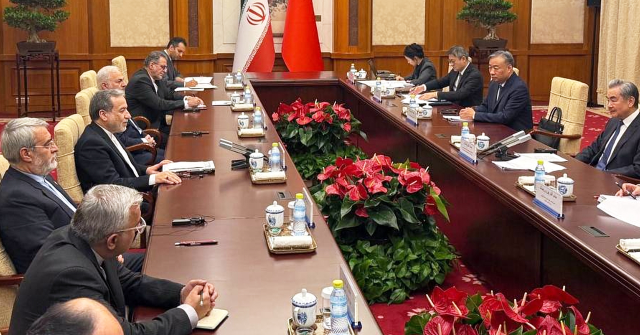
Iranian Ambassador to Beijing Abulreza Rahmani Fazli showered the Chinese Communist Party with compliments in an interview published in anticipation of President Donald Trump’s travel to China on Tuesday, celebrating China’s allegedly “key role” in navigating out of conflict in the Middle East.
The interview, published by the flagship Iranian state media network the Islamic Republic News Agency (IRNA), follows a visit by Iranian Foreign Minister Abbas Araghchi last week and multiple public attempts by what remains of the Iranian regime to ingratiate itself with China. China and Iran are traditional allies, sharing intense anti-American sentiment and commercial interests. China is Iran’s largest oil customer and helped shepherd Iran into the anti-American BRICS coalition in 2024.
Their relationship has been quietly strained since the launch of America’s Operation Epic Fury, however, which has eliminated dozens of senior Iranian officials and prompted Iran to launch a blockade of global commercial shipping traffic in the Strait of Hormuz. As one of the nations most dependent on that traffic for oil and other critical goods shipments, China has loudly complained that disruptions in the Strait must end as soon as possible, failing to add any conditional statements excusing Iran for its role in the problem.
The conflict with Iran and Strait of Hormuz traffic disruptions are likely to be among the top issues that President Trump discusses with his Chinese counterpart, genocidal dictator Xi Jinping, when he arrives in Beijing on Wednesday.
In anticipation of those discussions, Rahmani Fazli, the Iranian ambassador, emphasized Iran’s positive feelings towards China and the longevity of the Iran-China alliance in his remarks to IRNA.
“China is not viewed by Iran merely as an economic partner or energy buyer, but as part of a broader political balancing strategy against pressure, threats, and unilateralism,” Rahmani Fazli declared, celebrating China for opposing the American military operations to degrade Iran’s terrorist capabilities and its unsuccessful attempts to shoehorn itself into a mediation role in the conflict.
“The significance of China’s role lay in the fact that it viewed the crisis not through the lens of pressuring Iran, but from the perspective of containing the war and preventing the collapse of regional security,” he explained.
The ambassador described Iran as seeking to “redefine its diplomatic posture” beginning with sending Araghchi to China, as China has traditionally been sympathetic to Iran.
“From the onset, Beijing expressed opposition to the expansion of the war, because it knows that instability in West Asia is not a regional crisis only;” he argued. “It is tied with energy security, the global trade chain, and the power balance in the international system. From this viewpoint, China’s efforts to end the war were aimed at defending the principle of stability.”
Araghchi’s visit to China was marked by Foreign Minister Wang Yi sternly demanding that interruptions to traffic in the Strait of Hormuz, mostly caused by Iran, conclude.
“Regarding the strait issue, the international community shares a common concern over restoring normal safe passage through the strait. China hopes that the parties concerned will respond promptly to the strong calls of the international community,” the Chinese Foreign Ministry said in a readout following Wang’s meeting with Araghchi.
The Chinese government has offered few details on what it expects to discuss with Trump upon his arrival on Wednesday.
“President Xi will have in-depth exchanges of views with President Trump on major issues concerning China-U.S. relations and world peace and development,” Foreign Ministry spokesman Guo Jiakun told reporters during a briefing on Monday.
The Foreign Ministry largely avoided the subject of Iran during its briefing on Tuesday other than complaining about a new round of sanctions on its oil facilities that buy and process Iranian oil.
“We stand firmly against illicit unilateral sanctions that have no basis in international law or the authorization of the U.N. Security Council,” Guo insisted. “We will take resolute measures to protect the legitimate rights and interests of Chinese businesses and citizens.”
“On the Iran conflict, the pressing priority now is to prevent by all means a relapse in fighting, rather than to throw mud at China,” he added.
Iran and America are currently in a state of indefinite ceasefire, which Washington announced in April to allow for negotiations. President Trump appeared irritable about the matter in comments to reporters on Monday, calling the latest response from Iran to American proposals “garbage” and claiming that the ceasefire itself was “on life support.”
“I didn’t even finish reading it,” he said of the latest Iranian response in the negotiations.
“I would say the ceasefire is on massive life support,” he explained. “Where the doctor walks in and says, ‘Sir, your loved one has approximately a 1 percent chance of living.’”
Trump has complained in the past month that negotiations with Iran are difficult as various factions of the remnants of the Iranian government fight each other for influence and authority, in particular the civilian wing of the government, led by Iranian President Masoud Pezeshkian, and the military, led by the terrorist Islamic Revolutionary Guard Corps (IRGC). Typically, these tensions are managed by the dictator of the country, the “supreme leader.” Longtime Supreme Leader Ali Khamenei was killed on February 28, however, the first day of Operation Epic Fury, and his son, current “supreme leader” Mojtaba Khamenei, has made no public appearances or video or audio statements since been appointed the dictator, leaving unclear if he is in an adequate state to run the country.
“Nobody knows who is in charge, including them,” Trump claimed in late April. “Also, we have all the cards, they have none! If they want to talk, all they have to do is call!!!”