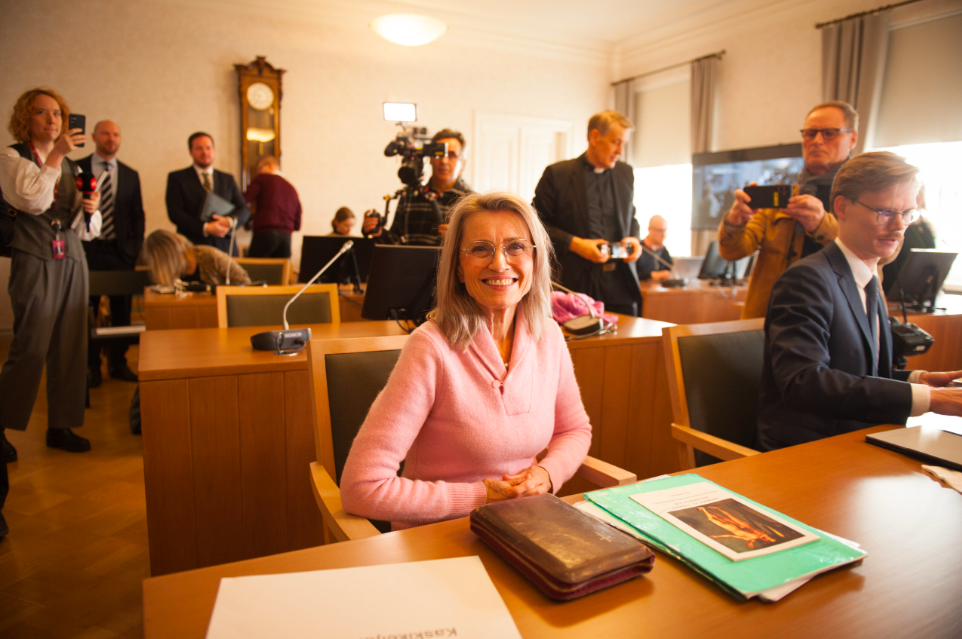
On 26 March the Finnish Christian MP Päivi Räsänen, together with the Finnish Lutheran bishop Juhana Pohjola, was found guilty in the Finnish Supreme Court on a 3-2 verdict of the crime of incitement against a minority group because of what she had written in a 2004 pamphlet Male and Female He Created Them – Homosexual Relationships Challenge the Christian Concept of Humanity, a pamphlet which the bishop published.
The prosecution of Räsänen, which began back in 2019, has attracted worldwide attention as an attack on the principle of freedom of speech. The article published on the website of the Alliance Defending Freedom, the Christian legal organisation which supported her defence, is typical of this response: “Across the world, freedom of speech is recognized as one of the most fundamental human rights. All major human rights treaties protect this freedom, and every democratic society is reliant on the ability of its citizens to speak freely.
“As a democratic country, Finland claims to protect free speech. But its prosecutor general has spent years doing the opposite.”
Päivi, ADF noted, was actually criminally charged under Finland’s ‘War Crimes and Crimes against Humanity’ law for ‘agitation against a minority group.’
Despite being cleared twice of all charges by lower courts, Finland’s Supreme Court sadly found Päivi guilty 3-2 for the 2004 pamphlet she published. The court unanimously upheld her acquittal for a tweet about same-sex marriage, while a separate charge relating to comments made during a radio debate was already acquitted in lower courts.
ADF added, “While it is right and just that these two acquittals stand, the conviction for publishing a decades-old pamphlet marks a dark day for freedom of expression.”
This article, and others like them, are accurate as far as they go, but what I want to consider here is that, in addition to such sentiments, there is the problematic nature of the specific reason given for the Supreme Court’s decision to convict Räsänen.
The offence for which she was convicted is spelled out in paragraphs 45-47, 51 and 57-58 of the judgment where she is referred to as ‘A’. It is long but it is worth quoting in full below to get a handle of the court’s logic.
In paragraphs 45-47 the judgement declares: “A has stated, among other things, that the underlying cause of sexually abnormal emotional life is disorders related to psychosexual development and that the scientific evidence inexorably demonstrates that homosexuality is a disorder of psychosexual development. She has denied the claim that homosexuality is a natural and healthy variation of sexuality. She has also stated that under certain conditions it is possible that sexual identity will be integrated towards a normal heterosexual emotional life and found that gay culture is part of the sexual abnormality as a whole.”
It then goes on to quote the 2020 “expert opinion” of the National Institute for Health and Welfare which the court claims “shows that, according to modern medicine (psychiatry), homosexuality is considered to be part of the normal spectrum of sexuality”.
The judgment continues, “It is not considered a physical or mental illness or a comparable disorder, and there are no medical grounds to characterize homosexuality as a psychosexual developmental disorder, psyche disorder, developmental disorder or developmental abnormality in relation to heterosexuality or psychopathological disorder or perversion.
“The claim of homosexuality as a disorder of psychosexual development is thus, in the light of the prevailing medical perception, an incorrect claim that can be considered insulting homosexuals.”
The Supreme Court goes on to spell out in more detail its issue with the pamphlet, which “further states that homosexuals are not considered equal to heterosexuals in the writing, since homosexuality is not considered a natural variation of sexuality and is claimed to be sexually abnormal, while heterosexuality is presented as a standard of normal, towards which a homosexual can possibly become whole”.
The judgment says that it is “also noteworthy that the article does not address the issue from the point of view of the problems that individual homosexuals may experience, but as a disorder of psychosexual development, which in the writing is associated with homosexuality in itself, i.e. all homosexuals as a group”.
The judgement then goes on to say in paragraph 51 that “the allegedly insulting passages in the indictment were not so much about the recognition of religion or faith, such as the expression of views based on texts considered sacred by religion or otherwise based on religious belief, but mainly on the argumentation based on the author’s social and medical view”.
“The Supreme Court considers that religious freedom does not protect the fact that opinions that are not related to religion are presented in the framework of religious writing,” the judgment reads.
Finally in paragraphs 57-58 the court “considers that the incorrect and insulting statements made in the article about homosexuals have been likely to maintain and strengthen the negative and even discriminatory attitudes that are often directed at homosexuals in Finnish society”.
“In particular, given that A is a widely known Member of Parliament, making statements available to the public has been likely to maintain the notion that it is acceptable to make such statements about homosexuals,” it reads.
“The expert opinion of the National Institute for Health and Welfare shows that the effects of homosexuality discrimination, negative attitudes and bullying have been studied and it has been found that these are associated with a risk of depression, anxiety and even self-harm. This supports the view of the harmfulness of the public expression of incorrect and insulting statements on homosexuals. In view of these considerations, the Supreme Court considers that interference in the proceedings by criminal law is necessary, despite A’s freedom of expression and religion.”
It concludes therefore that the offending statements in the pamphlet “have insulted homosexuals as a group on the basis of sexual orientation” and that “the consideration of the procedure as punishable is not incompatible with freedom of expression or religion”.
What these paragraphs make clear is three things.
First, that what Räsänen was found guilty of was making a supposedly scientifically incorrect statement about the nature of homosexuality, namely, that it was “a disorder of psychosexual development”.
Secondly, that the reason her statement must be ruled incorrect is because the Finnish National Institute for Health and Welfare said in 2020 that “there are no medical grounds to characterize homosexuality as a psychosexual developmental disorder”.
Thirdly, that because her incorrect view could contribute to psychologically harmful “discriminatory attitudes” to homosexual people she was therefore guilty of the crime of incitement against them.
These three things point in turn to three ideas that have become dominant both in Finland and in the Western world in general.
The first idea is that science is ‘god’ in the sense of the supreme and indisputable arbiter of truth. For the Finnish judges, the correctness or incorrectness of Räsänen’s theology was irrelevant, that was just her religious opinion. If she had simply said that those engaging in same-sex activity were sinners against God and would be damned at the last judgement, then there would have been no problem. It is because she has refused to ‘follow the science’ (to use the phrase popularized during the Covid pandemic) that she has become criminally liable.
The second idea is that science is a god who declares truth through authorised sources. Just as in the past statements by the Church would be regarded as authoritative, now it is the statement of the ‘National Institute for Health and Welfare’ (and parallel bodies in other countries) to whose judgement all must submit.
The third idea is that even if an individual has not incited harm to the lives or property of a group of people, they can nevertheless be regarded as guilty of criminal activity if they cause psychological harm by making ‘incorrect and insulting statements’ against such people (what is sometimes referred to by the short hand term ‘hate speech’).
These three ideas are very problematic.
The first idea is problematic because science is not God. Science, just like theology, is a human attempt to understand the reality of the world and the universe that we inhabit.
Furthermore, just as in the case of theological enquiry, the results of scientific enquiry are limited and fallible. Science, as I have just said, is a human enterprise and human beings are incapable of knowing everything, make mistakes, and are liable to believe and say either things not known to be true, or things known to be untrue, because of group think, and academic, commercial and political pressures. Anyone who has studied the history of science will be aware of all this and to pretend otherwise is simply foolish.
The second idea is problematic because just as individual scientists are fallible, so are ‘scientific authorities’ (who are, when all is said and done, groups of individuals). As before, history shows this. Appeal to scientific authorities has been used to justify, among other things, a belief that some racial groups are superior to others, that men are superior to women, that the socially or racially unfit should be sterilised, and that it is a good idea to lobotomise people with mental illness, all beliefs that we now rightly reject. The Finnish judges are therefore on very dodgy ground when they say that Räsänen must be wrong in principle (and therefore criminal) for not accepting the statement of the National Institute for Health and Welfare.
The third idea is problematic for three reasons.
First, truth is truth and must not be censored. If you go down the route of saying that no one can say that science indicates something because of the psychological harm that saying it might do to vulnerable minority groups, you will end up crippling scientific enquiry. For science to flourish scientists must be able to say controversial and difficult things and other people have to be free to refer to what they have said.
If people want to respond to those who say that science shows that same-sex attraction is a ‘disorder of psychosexual development’ then the correct response is not to invoke the criminal law to stop them saying it, but to continue to publish evidence showing that such a claim is mistaken in scientific terms.
Secondly, what the evidence shows is that the existence of churches that do not accept the legitimacy of same-sex relationships can actually be good for the mental health of LGBT people. In the words of Peter Ould in his article ‘Church teaching and LGB mental health’ which responded to a British report linking mental health problems among lesbian and gay people to the teaching of conservative churches: “The research evidence suggests this is an incorrect association to make, and indeed conservative churches may actually help reduce depression and other mental health issues in those LGB members and affiliates.”
Thirdly, the argument that it is necessary to prevent psychological harm is in fact part of a new liberal authoritarianism which uses an appeal to the supposed need to protect victims of oppression as a pretext for stifling dissent. As Carl Trueman explains in his book Strange New World, in today’s world:
“The claim that certain narratives are psychologically oppressive is plausible to many because our modern intuitions are to see ourselves as psychological beings and anything that obstructs our psychological happiness, our sense of self, is inevitably bad, oppressive, and something to be opposed. Victimhood has an intrinsic virtue to it; and anything that can lay claim to the vocabulary of the victim has unlocked a major, even irresistible, source of cultural power. Freedom of speech and academic freedom are simply licences to oppress and marginalise the weak. True freedom is found in closing down such traditional virtues and replacing them with a victim centred authoritarianism.”
This victim centred authoritarianism is precisely what we see on display in the conviction of Räsänen. Dissent is being criminalised by a liberal state to protect the alleged victims of conservative Christian teaching. Cultural, or in this case, legal power is being used to shut down scientific discussion.
What all this means is that in their response to the conviction of Räsänen, Christians need to be specific in their criticism. Rather than appealing in general terms to the need to protect freedom of speech, Christians need to explain the specific reasons why her conviction was problematic along the lines I have sketched out in this article.