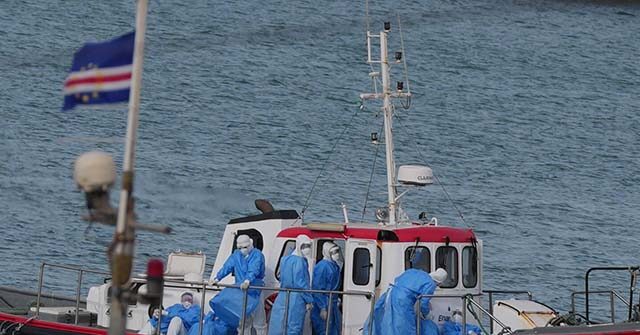
Sky News on Thursday spoke with Martin Antsee, a former police officer who was aboard the cruise ship MV Hondius during the deadly hantavirus outbreak. Antsee was airlifted to the Netherlands for treatment and remains in isolation.
“I’m doing okay. I’m not feeling too bad,” Antsee told Sky News.
“There are still lots of tests to be done,” he said. “I have no idea how long I’ll be in the hospital for. I’m in isolation at the moment.”
Antsee said his doctors expected to “have a clearer picture” about his health later in the week.
Antsee’s wife, Nicola, told the UK Telegraph on Wednesday that her family has been through a “very traumatic few days.”
“The fear with this virus is it can deteriorate very quickly so it’s been a bit up and down for him. I don’t believe he’s in imminent danger now, but it was horrible,” she said.
“He’s relieved to be off the ship. He had it quite mild then it got a bit more serious and now he’s stable again,” she said.
Antsee, 56, was working as an expedition guide on the cruise. He is one of three people evacuated from the Hondius since an outbreak of hantavirus was detected aboard the ship.
According to Sky News, 19 passengers and four crew aboard the Hondius are British. A 69-year-old British man was evacuated to a private hospital in Johannesburg, South Africa for emergency treatment, and remains in intensive care. Dr. Maria van Kerkhove, epidemic and pandemic preparedness director for the World Health Organization (W.H.O.), said on Thursday that he was “doing better” and another Briton taken to the Netherlands was “stable.”
Seven British passengers left the ship when docked at St. Helena on April 24. Two of them have since returned to the United Kingdom and are “self-isolating.” Four are still in St. Helena and are working with local health officials.
The seventh British passenger was unaccounted for until Thursday, when the U.K. Health Security Agency (UKHSA) said it was able to track the individual to a location outside Britain.
A total of 30 people departed from the ship at St. Helena. Another contact tracing challenge is that a visibly ill Dutch woman who left the ship at St. Helena flew to Johannesburg, potentially exposing passengers and crew on the plane. She boarded a flight from Johannesburg to the Netherlands but was removed from the plane. The woman died the day after arriving in Johannesburg and tested positive for hantavirus.
UKHSA Chief Scientific Officer Prof. Robin May said on Thursday that none of the British passengers still aboard the Hondius have tested positive for hantavirus.
“For the individuals that are on the ship at the moment, we’re working, obviously, to repatriate them as soon as we possibly can. The Foreign Office is leading on that, and once they’re back, they’re going to be asked to self-isolate,” said May, adding that 45 days of isolation would be the “likely” recommendation.
“We believe the risk from asymptomatic people of transmission is extremely low,” May said.
Hantavirus can kill up to a third of its victims through respiratory failure, it can take weeks for symptoms to manifest, and there is no known cure.
Only one strain of hantavirus is known to be transmissible between humans – and health experts appear increasingly convinced this “Andes strain” is one at work aboard the Hondius.
Kerkhove said that even the Andes strain of the hantavirus spreads through “close, intimate contact,” so its infection rate does not present a threat on par with the Wuhan coronavirus pandemic.
“This is not Covid, this is not influenza, it spreads very, very differently,” Kerkhove said.
W.H.O. Director-General Tedros Adhanom Ghebreyesus said his agency assesses the public health risk from the outbreak to be “low.”
Tedros said W.H.O. has traced the origin of the outbreak to two people who “travelled through Argentina, Chile and Uruguay on a bird-watching trip which included visits to sites where the species of rat known to carry the virus was present.” Hantavirus most commonly spreads through droppings from infected rats, who are not themselves injured by the disease.
Tedros noted that since the hantavirus incubates in humans for up to eight weeks, more infections from the outbreak could still present themselves.
There have been three confirmed cases of hantavirus infection aboard the Hondius so far, plus five suspected cases. Three people from the ship have died, but only one of them was confirmed to be a hantavirus fatality as of Thursday.
As of the last report, four of the people aboard the Hondius are Americans. Spanish civil protection director Virginia Barcones said the U.S. government has “shown its willingness to send a plane that will collect its citizens directly.”