Explosions and gunfire as armed groups launch coordinated attacks across Mali
Jake Laphamand
Makuochi Okafor,Lagos
 Reuters
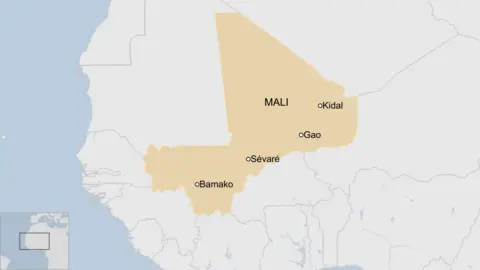
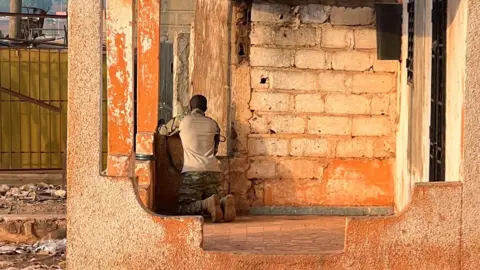
Explosions and sustained gunfire have been reported in Mali’s capital Bamako as armed groups launch apparently coordinated attacks across the country.
In a statement on Saturday the military said “fighting is ongoing”, adding “our defence and security forces are currently engaged in repelling the attackers”.
Witnesses have told the Reuters news agency of explosions and gunfire around the Kati military base, a major installation outside the capital. Soldiers have been deployed to block off roads in the area.
There are also reports of attacks in Gao and Kidal in the north and Sevare in central Mali, in what an analyst describes as the largest jihadist attack in years.
One resident, who was travelling back to Bamako from Ethiopia, told the BBC that all flights into the city were cancelled early on Saturday. It is not yet clear whether the reported attacks have affected the airport.
The US Embassy in Mali has advised citizens to shelter in place and avoid travel, citing explosions and gunfire around the Modibo Keita International Airport in Bamako and near Kati.
Ulf Laessing, head of the Sahel Programme at the Konrad Adenauer Foundation in Mali, told the BBC the incident appears to be the “largest coordinated jihadist attack on Mali for years”.
Mali’s military said it is fighting unidentified “terrorist groups” and the situation was under control, but unconfirmed reports suggest fighting continues. Videos circulating on social media suggest involvement of the jihadist group Jama’at Nusrat al-Islam wal-Muslimin (JNIM) and Tuareg Azawad Liberation Front (FLA) rebels.
Mohamed Elmaouloud Ramadane, a spokesperson for the FLA, said on social media that its forces had taken control of several positions in Gao and Kidal. He also urged neighbouring countries Burkina Faso and Niger not to intervene. The BBC has not been able to verify these claims.
Mali is currently ruled by a military junta led by Gen Assimi Goïta, who first seized power in a coup in 2020, promising to restore security and push back armed groups.
The junta had popular support when it took power, promising to deal with the long-running security crisis prompted by a separatist rebellion in the north by ethnic Tuaregs, which was then hijacked by Islamist militants.
The UN peacekeeping mission and French forces had been deployed in 2013 to deal with the escalating insurgency.
Both have left since the junta took over, and the military government has hired Russian mercenaries to tackle the insecurity.
However, the jihadist insurgency has continued and large parts of the north and east of the country remain outside government control.
Mali, Niger and Burkina Faso recently left the West African bloc Ecowas to form the Alliance of Sahel States. The bloc aims to share resources, build infrastructure, create a common market and currency and allow free movement of people, with the long-term goal of deeper integration.
All three countries are currently led by military governments following a series of coups.