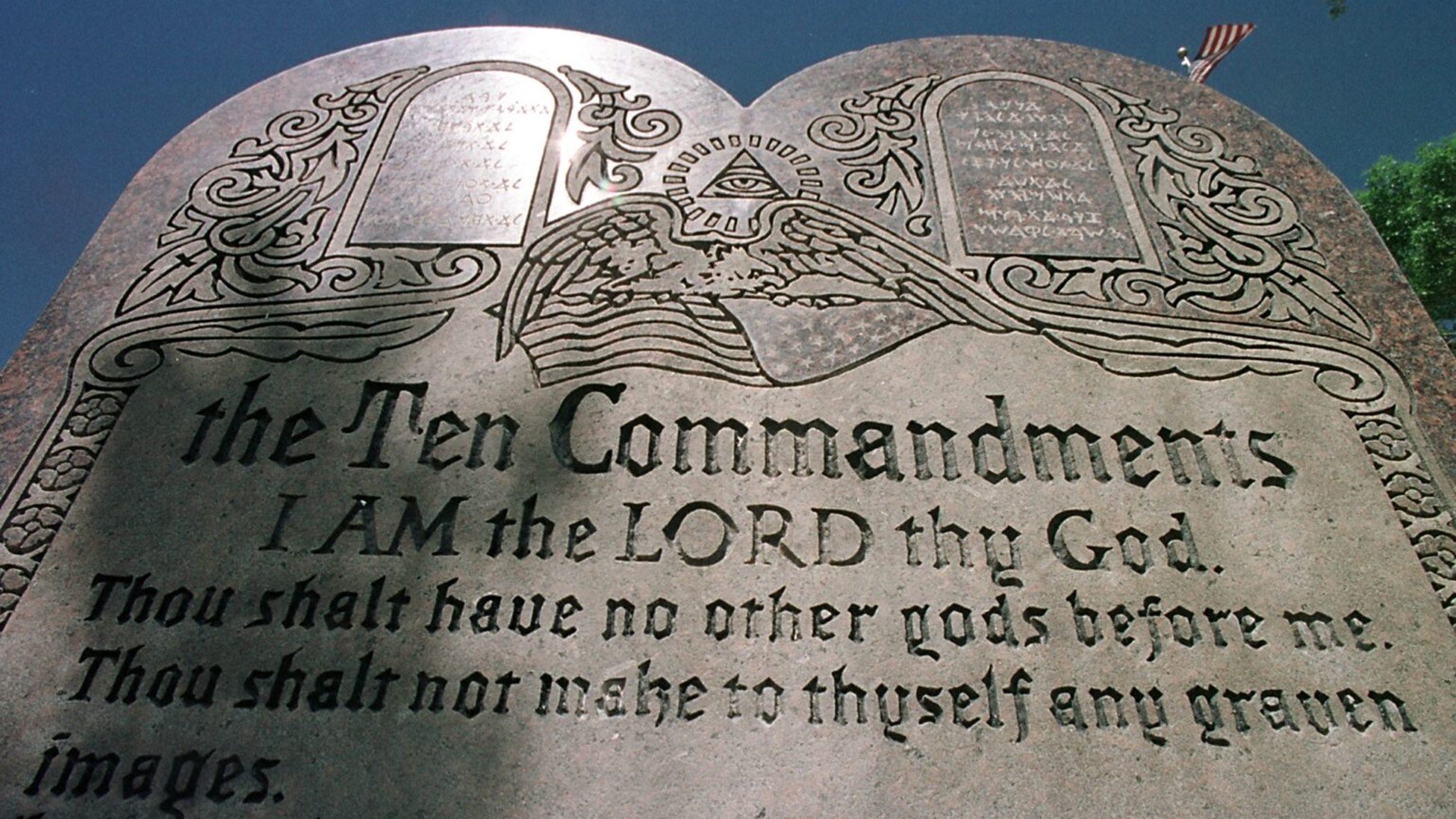


The 5th U.S. Circuit Court of Appeals ruled that the state of Texas can require the Ten Commandments to be displayed in public school classrooms, marking a victory for upholding the nation’s Christian foundation of the law.
The 9-8 decision overrules a preliminary injunction put in place by a federal district court judge in November, who concluded that “displaying the Ten Commandments on the wall of a public-school classroom as set forth in S.B. 10 [Senate Bill 10] violates the [First Amendment’s] Establishment Clause.”
The First Amendment says in part that “Congress shall make no law respecting an establishment of religion, or prohibiting the free exercise thereof.” But the Supreme Court has ruled that the Amendment’s protections apply to state law.
In the 5th Circuit’s majority opinion, Judge Stuart Kyle Duncan wrote, “To Plaintiffs, merely exposing children to religious language is enough to make the displays engines of coercive indoctrination. We disagree.”
“S.B. 10 authorizes no religious instruction and gives teachers no license to contradict children’s religious beliefs (or their parents’). No child is made to recite the Commandments, believe them, or affirm their divine origin.”
A federal court has upheld a Texas law requiring public schools to display the Ten Commandments. The court ruled that the requirement does not violate the rights of parents or students because “no child is made to recite the Commandments, believe them, or affirm their divine… pic.twitter.com/w9rn4nVyS8
— CBN News (@CBNNews) April 22, 2026
Further, “Students are neither catechized on the Commandments nor taught to adopt them. Nor are teachers commanded to proselytize students who ask about the displays or contradict students who disagree with them. Most importantly, the ‘coercion’ characteristic of religious establishments was government pressure to engage in religious worship.” The majority concluded that it was clearly not the case in posting the Ten Commandments in classrooms.
Judge Stephen A. Higginson, in his dissenting opinion joined by four others on the court, wrote that the framers of the Constitution “intended disestablishment of religion, above all to prevent large religious sects from using political power to impose their religion on others.”
“Our court accommodates their unconstitutional request, supplanting decades of Supreme Court precedent merely because of a single decision the majority deems outdated. In doing so, the majority defies foundational First Amendment concepts, ignores the harms students will face, and usurps parents’ rights to determine the religious beliefs they wish to instill in their own children,” he added.
The American Civil Liberties Union released a statement following Tuesday’s ruling, saying, “The Court’s ruling goes against fundamental First Amendment principles and binding U.S. Supreme Court authority. The First Amendment safeguards the separation of church and state, and the freedom of families to choose how, when and if to provide their children with religious instruction. This decision tramples those rights,” according to CBS News.
Texas State Sen. Phil King, who authored the legislation, called the 5th Circuit’s ruling a great day for Texas.
BREAKING NEWS: Today, the U.S. Fifth Court of Appeals rightly upheld SB 10, which I was honored to author in the Texas Senate, affirming our right to display the Ten Commandments in Texas classrooms. This is a great day for Texas! https://t.co/iyauaSuDAQ
— Phil King (@PhilKingTX) April 21, 2026
“As I have said all along, few documents in the history of Western civilization and in American history have had a larger impact on our moral and legal code, and our culture, than the Ten Commandments,” he said, according to CBS News.
“Returning this historical document to public school classrooms will provide moral clarity and allow students to better understand the foundation for much of American history and law. This is a great day for Texas!”
The Declaration of Independence refers to God four times, including in its very first sentence, “the Laws of Nature and of Nature’s God,” which were used to justify the United States’ separation from Britain.
The preeminent law book at the time of the founding, Blackstone’s “Commentaries on the Laws of England,” explained the meaning of the two sources of law referenced in the Declaration.
“Upon these two foundations, the law of nature [established by God and observable in creation] and the law of revelation [found in the Bible, directly revealed by God, including the Ten Commandments], depend all human laws; that is to say, no human laws should be suffered to contradict these,” Blackstone wrote.
As I explain in my book “We Hold These Truths,” the Ten Commandments recognize the right to life (“You shall not murder”) and the right to own property (“You shall not steal”).
The commandment not to covet your neighbor’s house “or anything that is your neighbor’s” is also an acknowledgement of the right to own property and a rebuke to the central tenet of socialism, namely, using the force of government to redistribute wealth.
Another commandment, “You shall not bear false witness,” creates the right not to be falsely accused of a crime — which, of course, would result in the loss of one’s life, liberty, or property. The right to due process of law in the Constitution is designed to protect the accused from false allegations.
The commandment to “honor your father and your mother” establishes the central role of family in society.
So, Sen. King is correct: The Ten Commandments are the foundation of American law. Therefore, Texas is right to give them a prominent place in the schoolhouse.
This article appeared originally on The Western Journal.
The post Appeals Court Sides With Texas on 10 Commandments in Classroom, Overruling Lower Court appeared first on The Gateway Pundit.