Order Robert Spencer’s new book, Holy Hell: Islam’s Abuse of Women and the Infidels Who Enable It: HERE.
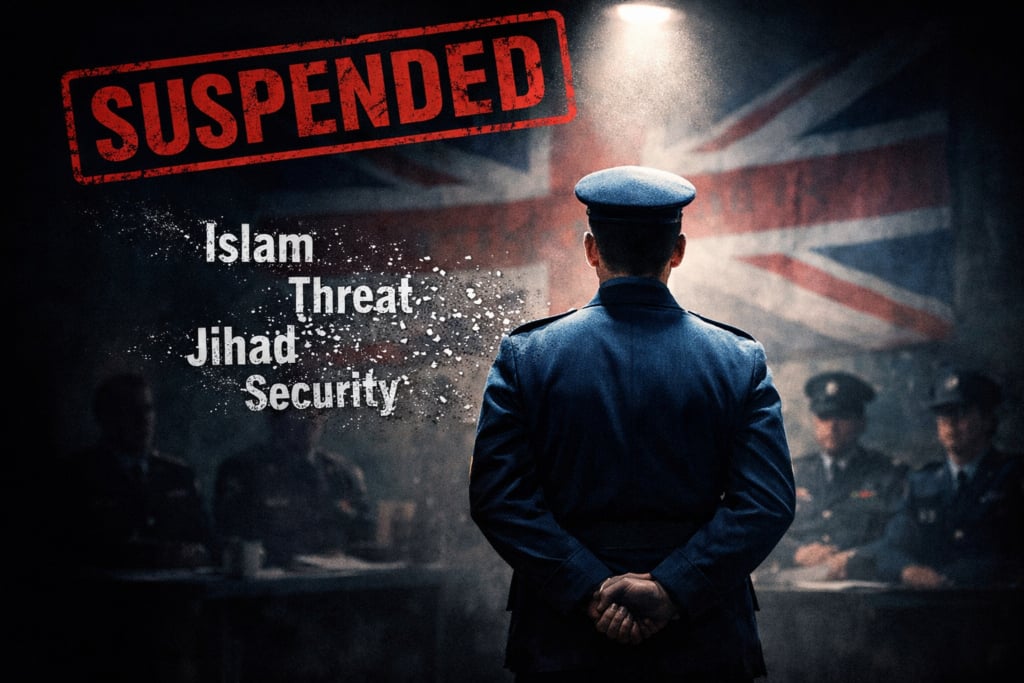
An RAF cadet has been suspended for thoughtcrime. The Daily Mail reported Saturday that the offending wrongthinker gained this suspension “after he said Islam poses the greatest security threat to the UK while taking part in a training exercise.” Retired rear admiral Chris Parry, who objected to the poor devil’s suspension, noted in passing that “if this cadet had answered ‘the far-Right’ I doubt he would have been suspended.” Indeed. And so the enforced fantasy and wishful thinking still prevail.
The cadet’s inexcusable wrongthink not only got him suspended; it “led to him being kicked off the officer-training course, pending an investigation.” The British air force has actually “launched a probe into the young cadet’s remarks at RAF Cranwell, where the next generation of officers are trained.”
Indignant, Parry “accused the air force of shutting down the ‘critical thinking’ of new officers around controversial issues and said the cadet should be reinstated.” He explained that if he had been teaching the class where the outrageous, offensive remark had been made, he would have handled it quite differently: “If I’d asked that question and got that answer I would have also asked the cadet to expand on his thinking and got some critical thinking going rather than suspend him.”
What Parry termed “critical thinking” was actually the enforcement of the British political and media establishment’s preferred fictions. “Clearly,” he said with a confidence that his ignorance did not justify, “Islamic extremism is the issue and not Islam, but how are young people expected to develop critical thinking around these complex issues if they are shut down in this way?”
Well, sure. British authorities should indeed not shut down honest discussion of the nature and magnitude of the threat of Islamic jihad and Sharia. At very least, this poor fellow’s suspension should be lifted long enough for Rear Admiral Perry to try to explain to him what he thinks is the difference between “Islam” and “Islamic extremism.”
“We know,” Parry said, again displaying a confidence that was as unshakeable as it was unjustified, “that Islam is not a threat, rather it is extremist elements, and this appears to have been a missed opportunity to discuss that for fear of causing offence.”
Could Parry actually show from mainstream Islamic theological sources the difference between Islam and “Islamic extremism”? Could he show us a sect or school of Islamic jurisprudence that is not political, supremacist, expansionist, and violent, and a Muslim-majority country that has implemented a vision of Islam that allows for non-Muslims to be granted rights equal to those granted to Muslims?
The answer to both questions is no. Parry could not do either one of those things, because what he considers to be “Islamic extremism” is actually mainstream Islam. Majid Khadduri, an internationally renowned Iraqi scholar of Islamic law, explains that “the Islamic state, whose principal function was to put God’s law into practice, sought to establish Islam as the dominant reigning ideology over the entire world. … The jihad was therefore employed as an instrument for both the universalization of religion and the establishment of an imperial world state.” Khadduri was talking about mainstream Islamic theology, not “extremism.” So is Islam the problem?
In a similar vein, in his 1994 book The Methodology of Ijtihad, Imran Ahsan Khan Nyazee, an assistant professor on the faculty of Sharia and Law of the International Islamic University in Islamabad, quotes the twelfth century Maliki jurist Ibn Rushd: “The primary goal of the Muslim community, in the eyes of its jurists, is to spread the word of Allah through jihad.” Iran’s former President Mahmoud Ahmadinejad once stated this idea a bit more crudely: “Have no doubt … Allah willing, Islam will conquer what? It will conquer all the mountain tops of the world.”
Some would contend that Ahmadinejad was an “extremist,” but he was president of the Islamic Republic of Iran from 2005 to 2013. Some claim that the Islamic Republic of Iran is itself “extremist,” but that argument is hard to sustain in light of the fact that it has held power for 47 years and counting without anyone inside or outside Iran explaining in any detail how it is misunderstanding or misapplying Islamic doctrine and Islamic law.
These truths, however, are forbidden to enunciate today in shattered, staggering, dhimmi Britain, as the suspension of this cadet illustrates. When reality is too hard to take, and would indict the policies of too many politicians, it must simply be ignored.
In order to eliminate spam comments that have historically flooded our comments section, comments containing certain keywords will be held in a moderation queue. All comments by legitimate commenters will be manually approved by a member of our team. If your comment is “Awaiting Moderation,” please give us up to 24 hours to manually approve your comment. Please do not re-post the same comment.