Paul SeddonPolitical reporter

 Getty Images
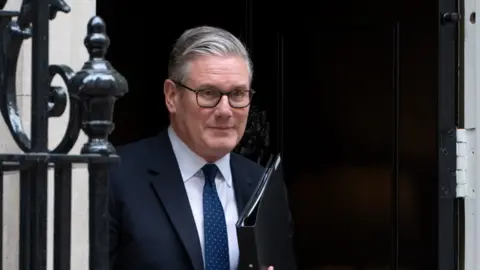
Sir Keir Starmer has been in the Commons again, defending his actions over the appointment of Lord Mandelson as ambassador to the US.
It comes after it emerged the peer was given security clearance for the role in January 2025, against the recommendation of officials who vetted him.
He formally took up the role the following month, and was sacked seven months later over his ties to the late convicted sex offender Jeffrey Epstein.
The PM blamed the Foreign Office
The prime minister had many angry words for the Foreign Office, the department that authorised Lord Mandelson’s clearance despite the vetting concerns from security officials.
He said the department’s officials should have informed him at the time – and then missed “repeated occasions” afterwards to make him aware, including when the UK’s then former top civil servant investigated Lord Mandelson’s sacking last year.
The repeated failure to divulge the result of Lord Mandelson’s vetting process was “incredible”, “staggering” and “astonishing”, the prime minister said.
And he went further, saying there had also been a “deliberate decision” to withhold information about the vetting process from MPs who had previously conducted an inquiry into Lord Mandelson’s sacking.
He argued the vetting result could have been shared
The vetting process involves asking applicants deliberately intrusive questions about things such as their finances, sexual history, health and family.
Sir Keir said he accepted that information gathered during this process – including from two interviews held with Lord Mandelson – should not be divulged.
But he added that, in his opinion, there was no reason why the overall vetting recommendation could not have been shared with him.
He suggested that this was a key point of difference between him and Sir Olly Robbins, the former top civil servant at the Foreign Office at the time, who was effectively sacked last week.
“He took the view this process did not allow him to disclose to me the recommendation,” the prime minister said, whilst adding that he “should have provided this information to me”.
Sir Olly is due to give his side of the story on Tuesday when he appears before a Commons committee – and his response to this point will be closely watched.
He denied misleading Parliament
A key accusation from opposition parties is that Sir Keir misled MPs last year when he told the Commons that “full due process” had been followed during Lord Mandelson’s appointment.
This is politically significant – because the government rulebook says ministers should not “knowingly mislead” Parliament.
Asked whether he might have inadvertently misled the Commons about what happened, he replied “no”.
He said he accepted that MPs, like him, should have been given more information, but added: “I did not mislead the House”.
He has ordered (another) security review
The prime minister revealed that he has ordered a review of “any security concerns raised” during Lord Mandelson’s time as ambassador.
Sir Keir confirmed that the peer had access to the highest level of secret material during his time in Washington.
He told MPs the review would be conducted by the Government Security Group, a unit within the Cabinet Office.
This is separate to another review, being led by retired judge Sir Adrian Fulford, into the wider national security vetting system.