Progressivism “requires of the people a subservience and weakness incompatible with a constitution premised on the transcendent origin of our rights.”
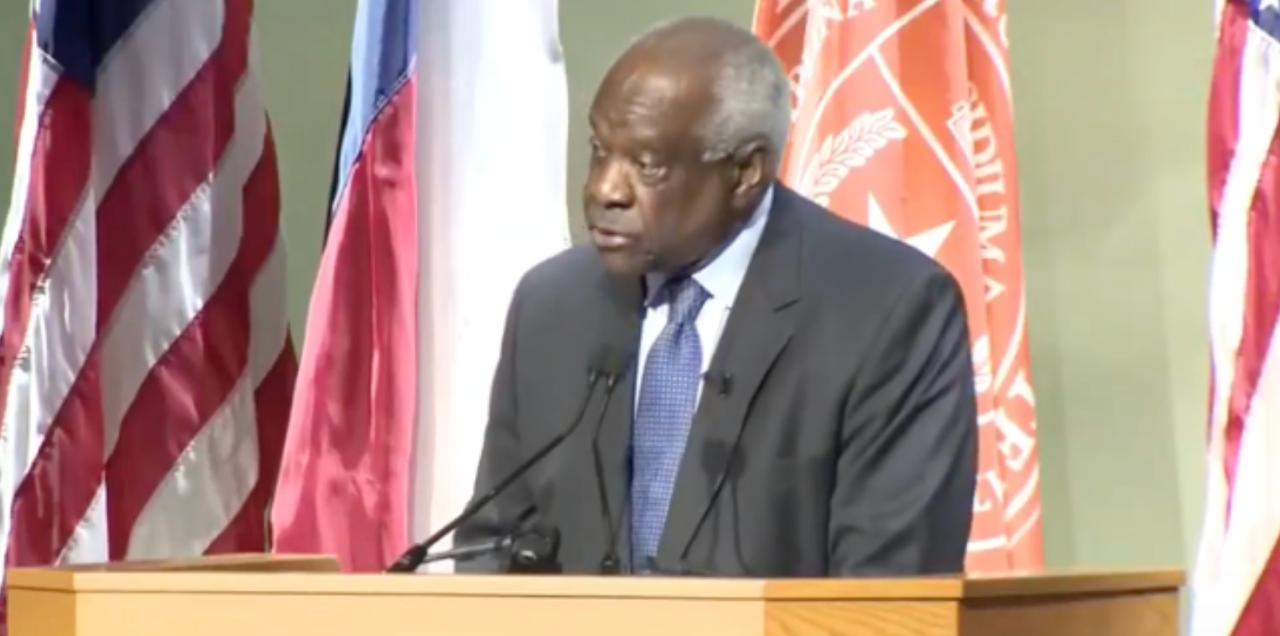
Supreme Court Justice Clarence Thomas spoke at the University of Texas in Austin on Wednesday night and he lashed out at the horrible political philosophy of progressivism, saying that it’s anathema to the Declaration of Independence and the goals set forth in that document. He praised the ethos of the Founding Fathers and urged Americans to not be “passive spectators” in American liberty, but to uphold the Declaration of Independence.
He spoke about his career, realizing early on in Washington, DC, that he had to define his principles and their worth. “What are your principles worth to you?” He said he asked himself.
“My answer then was the same I would give today: they are worth life itself. What are those principles? They are the same principles in the Declaration. They were bequeathed to me by my grandparents and reinforced by my nuns and my faith.
“In God’s eyes, we are equal. We are all equally created in the image and likeness of God. We are all endowed with the natural rights to life, liberty and happiness. Our rights and our dignity are inherent. They do not come from others, and they do not come from the government. And our government derives its legitimacy and its authority from our consent. We do not derive our rights from our government.
“The primacy of our rights in relation to our government is crucial in reconciling the mortal words of the Declaration with our Constitution and our history. None of our rights come from the government.
“All of the government’s authority comes from our consent, and the structure and limited role of government is to assure that it does not exceed the authority to which we have consented or intrude on our natural rights. The Constitution is the means of government. It is the Declaration that announces the ends of government.
“The Constitution achieves this purpose by protecting our natural rights and our liberties from concentrated power and excessive democracy. Our Constitution creates a separation of powers and Federalism, truly for the first time in modern history, to prevent the government from becoming so strong that it threatens our natural rights.”
It is progressivism, he said, that threatens those natural rights and in so discussing, goes back for 28th President Woodrow Wilson. “Since Wilson’s presidency, progressivism has made many inroads into our system of government and our way of life. It has coexisted uneasily with the principles of the Declaration, because it is opposed to those principles, it is not possible for the two to coexist forever.
“Progressivism was not native to America. Wilson and the progressives candidly admitted that they took it from Otto von Bismarck’s Germany, whose state-centric society they admired. Progressives like Wilson argued that America needed to leave behind the principles of the founding and catch up with the more advanced and sophisticated system of relatively unimpeded state power, nearly perfect, perfected.”
Thomas went on to say that “Progressivism seeks to replace the basic premises of the Declaration of Independence and hence our form of government. It holds that our rights and our dignities come not from God, but from government. It requires of the people a subservience and weakness incompatible with a constitution premised on the transcendent origin of our rights.
“You will not be surprised to learn that the progressives had a great deal of contempt for us, the American people. Before he entered politics, Wilson would describe the American people as, quote, selfish, ignorant, timid, stubborn and foolish. He lamented that we do too much by vote and too little by expert rule.
“He proposed that the people be ruled by administrators who use them as tools. He once again aspired to be like Germany, where the people, he said admiringly, were docile and acquiescent.
“The Century of progressivism did not go well. The European system that Wilson and the progressives scolded Americans were not adopting, which he called nearly perfect, led to the governments that caused the most awful century that the world has ever seen. Stalin, Hitler, Mussolini and Mao all were intertwined with the rise of progressivism, and all were opposed to the natural rights on which our declarations are based.”
And he urged Americans to be courageous and to stand up for these principles. “As we are gathered to celebrate the 250th anniversary of the Declaration,” he said, “it may be tempting to do so as if we are passive spectators. It may be tempting to enjoy our tea and crumpets, treat the Declaration like a shiny object or a keepsake, and listen to the sound of our own voices.
“We could get into debates over whose conception of the founding is better, over how we are so much better than our founders were, over what we would do differently. We could be careful to not do anything that exposes us to criticism, costs us friends or hurts our career prospects. But in my view, we must find in ourselves that same level of courage that the signers of the Declaration had so that we can do for our future what they did for theirs,” he said.
“Each of you will have opportunities to be courageous every day, whether your calling in life is as a day laborer, a stay-at-home mom, a small business owner, an educator, an office worker, a judge or some other endeavor. It may mean speaking up in class tomorrow, when someone around you expects you to live by lies. It may mean confronting today’s fashionable bigotries such as antisemitism,” Thomas went on.
“It may mean standing up for your religion when it is mocked and disparaged by a professor. It may mean not budging on your principles when it will entail losing friends or being ostracized. It may mean running for your school board when you see that they are teaching your children to hate your values and our country. It may mean turning down a job offer that requires you to make moral or ethical compromises. One thing I do know to be true, it will mean waking up every day with the resolve to withstand unfair criticism and attacks.
“These are the choices that we will confront, that will confront you, and you must decide whether to respond with timidity or with courage as the signers of the Declaration did. It will, of course, not be easy. It never is. But if, like me, you need a greater source of strength than yourselves, you will need to rely on your faith to guide and to sustain you through it all.Yyou will disappoint people you thought were friends and endure personal attacks as well as attacks on those you care about. But if you stand, you will find that courage, like cowardice, can be habit-forming, and it will become a part of your life and a part of who you are.” He said further that it will be liberating to do so.