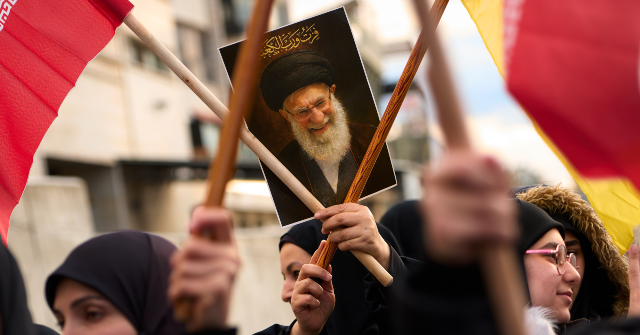
The Islamist ruling regime of Iran hosted mourning events nationwide on Thursday for longtime dictator Ayatollah Ali Khamenei marking 40 days since his elimination, organizing large crowds to honor him but notably failing to attract the public presence of his son, current “supreme leader” Mojtaba Khamenei.
The events on Thursday were the first large-scale, government-mandated assemblies since both Iran and the United States announced, with the mediation of Pakistan, a two-week ceasefire ending the active hostilities that began in late February. On February 28, President Donald Trump announced the launch of Operation Epic Fury intended to degrade Tehran’s illicit nuclear development and missile and drone arsenal. He also announced that the operation had killed the elder Khamenei that day.
In conjunction with the Israel Defense Forces (IDF), the Pentagon operation has eliminated dozens of senior leaders in the Iranian government, leaving unclear who is running the government and issuing official statements — whether the Islamic Revolutionary Guard Corps (IRGC), a terrorist organization, or President Masoud Pezeshkian. Pezeshkian is subordinate to the “supreme leader,” as is the IRGC, so without the confirmed involvement of Mojtaba Khamenei in government affairs, Iranian leadership at press time remains unclear.
The Iranian government announced in March that the younger Khamenei would succeed his father and, while several written statements have been published in his name since then, he has yet to make any public appearances or publish audio messages that could be confirmed to carry his voice. In his absence, Pezeshkian and Foreign Minister Abbas Araghchi have made public appearances, including walking the streets of Tehran to assert their authority.
Reports on Thursday’s marches indicate that Pezeshkian attended them, but Khamenei did not — even though Iranian state media declared that one purpose of the assemblies was to declare allegiance to the “supreme leader.”
According to the Tasnim News Agency, Iranian officials mandated mass assemblies through 8 p.m. local times on Thursday to engage in “mourning the martyrdom of the Imam of the Ummah [Muslim community].”
“By holding pictures of the martyred leader of the revolution and chanting slogans, the participants express their sympathy with him,” Tasnim reported. “Also, the audience released their cry on the street of the Islamic Republic and declared their allegiance to Ayatollah Seyyed Mojtabi Hosseini Khamenei, the Supreme Leader of the Islamic Revolution.”
State media published videos of large crowds carrying images of the elder Khamenei and Iranian flags throughout the country.
Shiite Muslims typically mark the 40th day since a person’s death by visiting their burial site and praying for them. The Iranian government has not confirmed that Khamenei was ever buried, however, suggesting they’ve kept the “supreme leader’s” final resting place a secret.
The independent outlet Iran International reported that many Iranians online questioned the reason for such mass events when there is no tomb to visit.
“Forty days have passed and his corpse is still lying around. The fortieth is a sacred day in Shiite tradition, when people gather at a grave for a proper ceremony. But for him, none of that is possible,” the outlet quoted one observer online as noting. Others mocked the regime for using a Christian church in Tehran for one its mourning events, given its strident jihadist character.
The IRGC separately published a statement on Thursday marking the occasion, declaring that Khamenei was “as influential as his lifetime” following his death and celebrating that Iran had allegedly delivered “one hundred lethal blows” to the United States, without elaborating. While dozens of Iranian government officials have been killed in the current hostilities, the United States is not known to have lost any government officials, nor have any such injuries been documented.
The IRGC also made sure to pledge its loyalty to Mojtaba Khamenei.
The status and whereabouts of the alleged new “supreme leader” have been a mystery since the elder Khamenei’s demise. Following the declaration that he would be the nation’s new dictator, Iranian state media published photos and read a written statement allegedly from the younger Khamenei. The Iranian government held events forcing citizens to pledge allegiance to posters of Khamenei, but he had yet to be seen in public. In the absence of information, wild rumors began spreading alleging that Khamenei was severely injured, hospitalized, or unconscious. Some rumors also claimed that Khamenei was homosexual, but did not explain how that would impact his ability to appear in public.
On Monday, the U.K. Times reported that Khamenei was unconscious in a hospital in Qom. On Tuesday, the Washington, DC, website Axios reported that American and Israeli officials learned on Monday that Khamenei had directly intervened to ensure a ceasefire. None of the authorities of the countries involved have confirmed any such rumors.