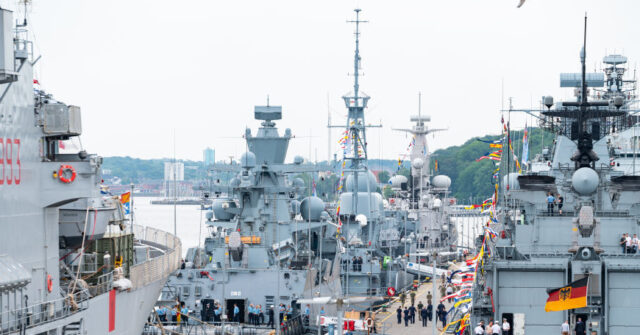
A group of 15 nations including the UK, France, and Japan put their name to a document welcoming the Iran ceasefire and promising to “contribute” to securing the Persian Gulf, offering few specifics on how they will do so.
The United Kingdom is leading a group of countries from around the world in talks to commit to a potential future effort to secure the Strait of Hormuz, the critical waterway through which much of the world’s daily seaborne oil trade flows in normal times.
Seeing this trade restored is very much in the interests of the nations involved: most Hormuz-transit oil goes to Asia, but the constraint on supply still impacts the global commodity price. Yet despite having over five weeks of warning that the time to act was coming, the arrival of a ceasefire this week appears to have left the nations, if not in the talking about talks stage, where they were weeks ago, then at the stage of just talking.
Nevertheless, speaking on U.S. media on Wednesday evening, the Secretary General of NATO Mark Rutte praised President Trump for having made the world safer by destroying Iran’s nuclear ambitions and ballistic missile programmes and cited the forthcoming mission to secure the Strait, which he said would be led by NATO members.
The Secretary General told CNN, “let’s not forget Keir Starmer, the British Prime Minister, who is bringing together now a coalition of over 30 countries, even over 40, but 34 participated yesterday in a planning meeting with military leaders to make sure that free sea lanes, being able to use the Strait of Hormuz, going forward would be possible.”
Precisely who these 40 nations are is not definitively public, but many supporters of the theoretical mission to the Strait have made their intended contribution public. In a joint statement published on Wednesday, 15 heads of government of the United Kingdom, Germany, France, Japan, Italy, Canada, Spain, the Netherlands, Sweden, Norway, Denmark, Romania, Greece, Finland, and Iceland said they welcomed the ceasefire and called for it to be expanded to cover Lebanon. The statement was also signed by representatives of the European Union and by Spain despite the country having previously made a fuss about not wanting to be involved.
Britain’s Prime Minister Sir Keir Starmer said of the document: “Alongside our international partners, the UK will work to ensure a return to freedom of navigation in the Strait of Hormuz”.
While his diplomatic visit to the Middle East yesterday after the U.S.-Iran ceasefire was widely mocked as an attempt at glory-hunting after the bombs had stopped flying, he explained part of the purpose was negotiating with partners in the region who would make the Strait of Hormuz mission possible, potentially by providing bases for visiting Western warships.
“We’ve just reached this ceasefire which is welcome … but there’s work to do, and I’m here in Saudi Arabia … to carry out that work in support of what we’re all seeking,” Starmer told Sky News, “which is that this ceasefire should not be a temporary ceasefire, but a permeant ceasefire.”
“On top of that we have to acknowledge that this war wasn’t our war, but my job is to protect the UK. It’s already had an impact on the UK, and it’s very important that we get the Strait of Hormuz open,” he continued. “There’s a lot of work to do there. … I now get the opportunity here in Saudi Arabia and countries nearby in the region to have these discussions, coordinate our actions, and go forward collectively in pursuit of those two missions.”
The question over the actual ability of this group of nations to affect change in the Strait remains. Between the 15 signatories on Wednesday and the wider group of nations putting their names to the desire to see Hormuz opened in recent weeks, several countries do not even have navies in any meaningful sense, and those that do are shadows of their former selves. Some members that are more militarily capable have concerns in their home waters that may dissuade them from letting any of their precious ships be detached for the Middle East, not least among them Britain with its Russian submarine panic and Japan watching the Taiwan Strait.
France’s President Macron has dismissed joint military action to secure freedom of navigation as “unrealistic. Britain’s Foreign Minister Yvette Cooper said on Thursday that Britain will insist Iran levies no tolls on the Strait of Hormuz and will reportedly say at a major speech tonight, “the fundamental freedoms of the seas must not be unilaterally withdrawn or sold off to individual bidders”.
Freedom of navigation in contested waters relies on there being a military power with a capable navy and political will to enforce norms. This was once the United Kingdom and, even in recent memory, the Royal Navy was a formidable enough force to credibly enforce freedom of navigation. Yet decades of political decisions to strip funding from the military to fund welfare programmes and health care instead has left the country unable to enforce the global security conditions it claims to be essential.
Part of the logic for this draw-down has been Westminster’s belief that the era of hard power was essentially over and that Britain was a “soft power superpower,” that its admittedly considerable cultural and diplomatic weight was enough. As Prime Minister Starmer launches his Middle East speaking tour in the wake of the Pakistan-brokered ceasefire between the U.S. and Iran, the rubber of that theory is to hit the road of reality. For the time being, the United States will remain in the Strait of Hormuz doing the job President Trump repeatedly asked his allies to take over.