
Power-washing, pool-cleaning and mowing: Why millions are playing games about mundane jobs
Laura CressTechnology reporter

 FuturLab
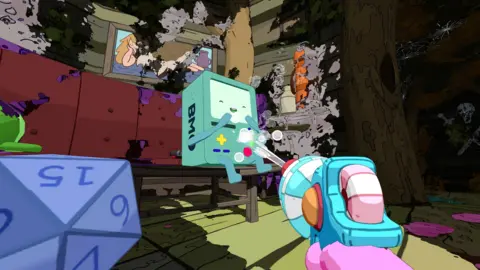
PowerWash Simulator sees players don their cleaning gear and hose down a variety of filthy in-game locations until they’re sparkling and spotless.
While it may seem like an unusual premise, the original game from 2021 has sold more than 17 million copies. The sequel, released in 2025, has just been nominated for two Bafta Games Awards.
Both fall under the category of “mundane job simulations”, an ever-growing gaming genre in which people carry out routine and – on the face of it – not very exciting tasks.
“We want to make the Graham Norton of video games,” says Kirsty Rigden, the chief executive of Brighton-based FuturLab, which makes PowerWash Simulator.
Aspiring to emulate a talkshow host who has a reputation for being affable rather than for setting pulses racing is perhaps an unusual ambition for a gaming studio.
But she says there is a big market for lower-octane entertainment.
“Graham Norton doesn’t make you feel stupid, but you also don’t have to think too hard,” Rigden told BBC News.
“It engages the right amount of brain and at the end of it you go, ‘Oh, that was really pleasant’.”
 Futurlab
One of the core characteristics of the simulation genre is its soothingly repetitive jobs.
In PowerWash Simulator’s case that means cleaning through one mucky area – say, a fun house or a roller disco – after another; quite literally rinse and repeat.
“I think it’s really struck a chord with how people are feeling in the world right now – the world is in quite a stressy place,” Rigden said. “With the game you are able to focus in on one thing, which kind of blocks all the other distractions out – it’s a pure form of meditation.”
The initial idea came from a personal interest Rigden had in watching YouTube videos of people power washing and the “simplicity of seeing dirt turn to cleanliness”.
 Kirsty Rigden
Social media is awash with influencers – some with hundreds of thousands of followers – making content about cleaning or clearing up, and FuturLab’s series is not the only simulator to have tapped into the trend.
In Lawn Mowing Simulator players “experience the beauty and detail of mowing the Great British countryside” by running a lawn care business, using “real-world licensed lawnmowers”.
A sequel, promising to take players to the “trailer parks and town hall gardens” of America, is currently in the works.
David Harper, managing director and founder of Liverpool-based developers Skyhook Games said players often use the game as an “escape” from the pressures of everyday life.
“It’s basically about the satisfaction of starting with something untidy, learning the skills to bring order to the scene, then looking back at a job well done,” he said.
 Skyhook Games
The relaxed nature of mundane job simulators has made them a particular hit with YouTubers and Twitch streamers, who can strike up a conversation with viewers without needing to pay too much attention to the game.
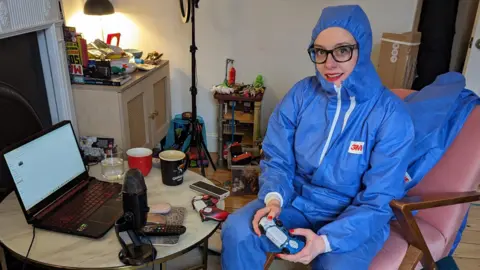
Comedian and games journalist Ellie Gibson started streaming the game to her Twitch community after a friend recommended she try it.
The attempt went relatively smoothly, she explains, apart from a “nightmarish” section when cleaning a kid’s playground at four in the morning where the game’s bright primary colours affected her in “a very psychedelic way”.
But she added the “calming and soothing” nature of the game is similar to what she imagined “people get from colouring books or knitting”.
“You get the finished result of a clean monster truck, rather than a scarf.”
 Helen Thorn
Both Rigden and Harper say they have had a number of people get in touch to tell them their games have helped them through difficult times.
“Hearing how our game has helped our players with their anxiety and mental health has been really rewarding to us,” said Harper.
Meanwhile, Rigden said they had “lots of people writing in and saying how we’ve helped them get through things like cancer treatments.”
“It’s really lovely and uplifting.”
PowerWash Simulator has even been the subject of an Oxford University study, which looked at whether video games affected players’ wellbeing.
In March 2023, more than 8,600 players tracked their mood every 10 minutes with pop-up prompts while playing a custom build of the game.
The study found 72% of players experienced an uplift in mood while playing the game.
 FuturLab
While Nick Ballou, one of the researchers behind the study, said it was unlikely mundane job simulators would ever be comparable to something like therapy, he believed they still had a couple of “unique benefits”.
“These games are particularly suitable for people with low energy, and they’re really effective in absorbing attention,” he said.
“I do think playing them can be more mindful than other games that require lots of cognitive engagement to coordinate with teammates or react in a split second.”
As for Rigden and the team, there is a plan to make a game separate to the soapy empire they’ve currently worked up into a lather – as they continue their goal to become “the market leader in cathartic games”.
Whatever the team work on next, there’s one unique element which will undoubtedly remain – their unusual, yet perhaps fitting, Graham Norton ethos.