
 Getty Images
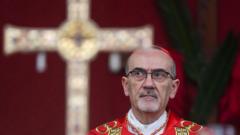
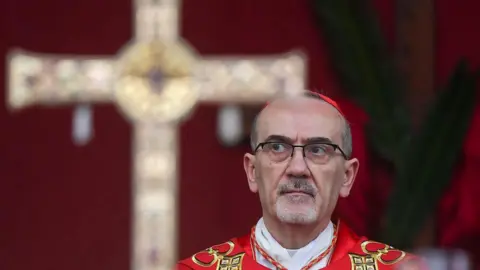
Israel’s prime minister has said the Latin Patriarch of Jerusalem will now have “full and immediate access” to the Church of the Holy Sepulchre, after police earlier prevented him from celebrating Palm Sunday Mass there.
Benjamin Netanyahu said Cardinal Pierbattista Pizzaballa, who is head of the Catholic Church in the Holy Land, had been asked not to enter the church out of concern for his safety. He said Iran had repeatedly targeted Jerusalem’s holy sites with ballistic missiles.
The decision to block the cardinal from entering Christianity’s most sacred site had been criticised by several Western nations.
On Sunday Cardinal Pizzaballa and the Reverend Francesco Ielpo were stopped outside the church, believed to be the site of Jesus Christ’s crucifixion, as they were planning to hold a Mass to mark the start of Holy Week, church authorities said.
Cardinal Pizzaballa’s office said it was “the first time in centuries” a Latin Patriarch had been turned away from the holy site on Palm Sunday, which marks Christ’s return to Jerusalem.
He and Rev Ielpo had been “compelled” to turn back from the church, where Christ was also believed to have been buried and subsequently resurrected, it said.
A statement from the patriarchate on Sunday said: “This incident is a grave precedent and disregards the sensibilities of billions of people around the world, who during this week, look to Jerusalem.”
But in a later statement released on Monday, Cardinal Pizzaballa’s office said the matter had been “addressed and resolved” and expressed “sincere gratitude” to Israel’s President Isaac Herzog for intervening in the matter.
The cardinal’s office said it hoped “appropriate arrangements will continue to be found, enabling prayer to take place in places of worship, particularly in the Holy Places of all religions.”
This was a matter of “profound importance to hundreds of millions of believers,” it added.
The US ambassador to Israel, Mike Huckabee, said on Sunday that the move to stop the cardinal from accessing the church was “difficult to understand or justify”. But in a later statement on social media he said the issue had been resolved.
 EPA
EPA
Before the decision was made to allow Cardinal Pizzaballa full access to the church, Netanyahu said worshippers of “all faiths” had been asked not to visit sites in Jerusalem’s Old City, which had been subject to strikes from Iran, and that police had acted out of “special” safety concerns in this instance.
The traditional Palm Sunday procession into the city had already been cancelled due to restrictions on public gatherings.
Israeli police said all holy sites in the Old City had been closed to worshippers since the US-Israel war against Iran began on 28 February for security reasons, and that it had rejected the patriarchate’s request for a Palm Sunday exemption.
Netanyahu said holy sites belonging to Christian, Jewish and Muslim worshippers had been “repeatedly targeted” by Iranian missile strikes in recent days.
“In one strike, missile fragments crashed meters from the Church of the Holy Sepulchre,” he said in a statement on X, adding that Sunday’s decision involved “no malicious intent whatsoever”.
A plan was being drawn up to allow Church leaders to worship at the site in the coming days, he said.
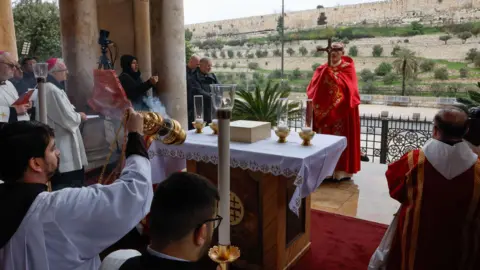
Then, late on Sunday night, Netanyahu announced he had instructed relevant authorities to grant the Latin Patriarch “full and immediate access” to the Church of the Holy Sepulchre so he can “hold services as he wishes”.
A US state department spokesperson told BBC News: “We encourage the Government of Israel to facilitate the safe observance of Holy Week.”
They also noted “the difficult security conditions in Jerusalem that have arisen from Iran’s ongoing, indiscriminate missile attacks”.
Italian Prime Minister Giorgia Meloni had earlier criticised the lack of access as “an offence not only against believers but against every community that recognises religious freedom”, while Foreign Minister Antonio Tajani said he had summoned Israel’s ambassador to Italy for an explanation.
French President Emmanuel Macron had likewise condemned it and said it came in the context of “the worrying increase in violations of the status of the Holy Places in Jerusalem”.
“Freedom to hold religious rites in Jerusalem must be ensured for all religions,” he said in a statement on X.
And Pope Leo XIV, speaking in Rome on Sunday, paid tribute to “the Christians of the Middle East, who suffer the consequences of a terrible conflict and in many cases cannot fully live the rites of these holy days”.
Herzog said he reaffirmed “Israel’s unwavering commitment to freedom of religion for all faiths and to upholding the status quo at the holy sites of Jerusalem”.