Dearbail JordanBusiness reporter
One of the UK’s largest energy suppliers has said an increase in household bills was “inescapable” if oil prices remain high due to the Iran war.
Chris O’Shea, boss of British Gas-owner Centrica, told the BBC that the effective closure of the Strait of Hormuz had affected the supply of oil far more than gas, and that it was still “too early to speculate” on what this would do to energy prices.
But he pointed to a forecast by consultancy Cornwall Insight that bills in England Scotland and Wales could rise by an average of £332 from July, after falling by £117 from April due to the energy price cap.
If the situation remained the same in that time, “then I think that’s inescapable”, he said.
Since the US-Israel war with Iran began, oil and gas prices have soared, with crude up 45% to $106 a barrel.
Around 20% of the world’s oil usually flows through the Strait of Hormuz, but Iran targeting shipping through the vital waterway has effectively brought it to a complete halt.
But O’Shea said only 3-4% of the global gas supply had been lost due to the closure of the strait.
“So, the impact on gas, and therefore on electricity bills, should be lower than the impact on oil,” he told the BBC’s Sunday with Laura Kuenssberg programme.
“So my gut feel is that you’ll see more of an impact of this in the petrol pumps than you will in bills.”
Asked about government support with energy bills, O’Shea said “targeted” would be “far better than blanket help”.
On Monday, the prime minister will hold an emergency meeting with senior ministers and the Bank of England governor to discuss measures to counter the potential impact of the war in the UK, including on the cost of living.
Housing Secretary Steve Reed told the programme that the government was already taking action on energy bills, including a £53m package for homes struggling with a sharp increase in the price of heating oil.
The discussion of ways to mitigate any energy price rises came after the government’s cost-of-living tzar, Lord Walker, who is also chief executive of supermarket chain Iceland, suggested in the Sunday Times that energy companies and petrol stations should have their profits temporarily capped as oil prices jump.
But Reed appeared to rule this out, saying a cap was not currently necessary.
“We’re monitoring this, believe me, hour-by-hour,” he said. “As intervention is required, the government in making appropriate interventions but we’re already focussing on keeping bills down.”

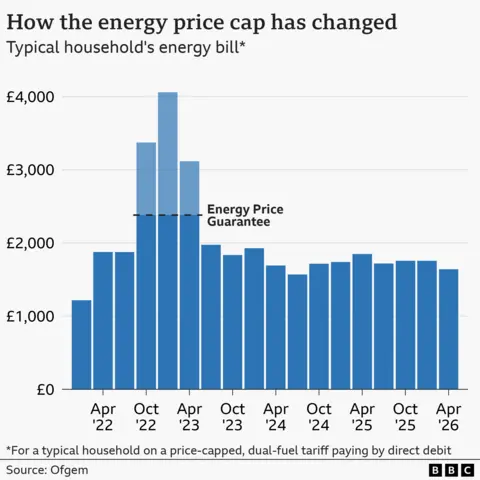
O’Shea questioned how a cap on energy firms’ profits would work and pointed to the Energy Profits Levy – also known as the windfall tax – which was introduced following Russia’s full-scale invasion of Ukraine in 2022.
The profits of companies extracting oil and gas in the North Sea are taxed at a rate of 78% under it. The measure was introduced under the Conservative government and extended until 31 March 2030 under Labour.
O’Shea said: “If you’ve got a situation where the Exchequer takes four fifths of what you’re making, I’m not sure there’s much more room for manoeuvre.”
The Centrica boss also suggested that the government should allow further oil and gas exploration in the North Sea as a way to alleviate potential energy price rises, alongside increasing gas and battery storage, as well as renewable generation.
“Nothing in and of itself will fix this but these activities will bring prices down. They won’t isolate the UK – we’re part of a global system – but they will bring prices down.”
He said that the price of gas was set by international markets regardless of whether it came from the North Sea or the Middle East.
There are also concerns that further exploration would lead to new fossil fuel supplies being found and extracted, increasing the UK’s carbon footprint rather than reducing it.
O’Shea said allowing oil and gas exploration was not a “silver bullet” but “it makes sense, if you’ve got resources”.