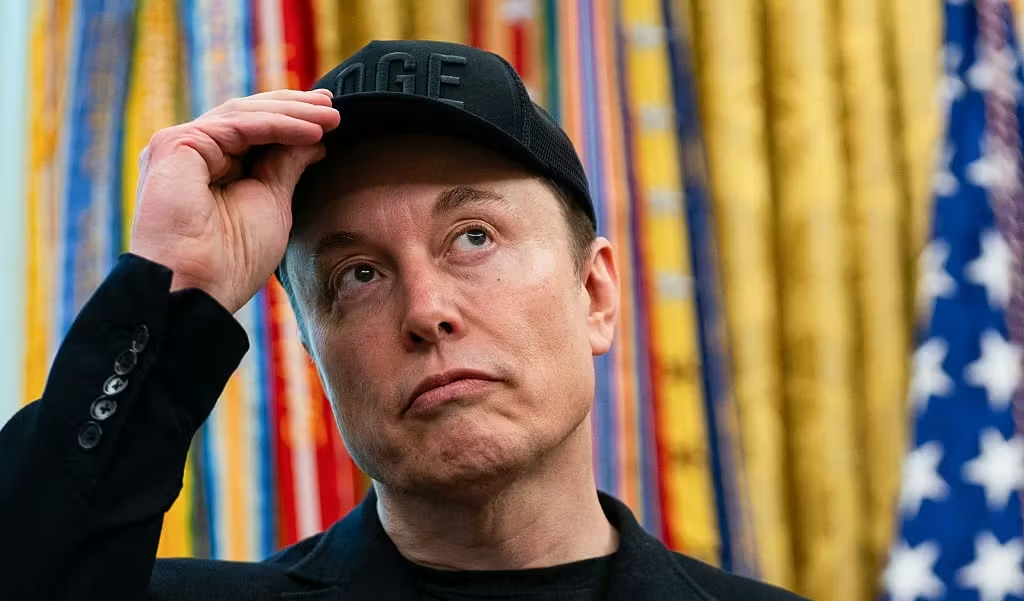
Elon Musk recently offered to personally cover the salaries of TSA agents as a partial Department of Homeland Security shutdown stretches into its second month, leaving tens of thousands of federal workers without pay.
“I would like to offer to pay the salaries of TSA personnel during this funding impasse that is negatively affecting the lives of so many Americans at airports throughout the country,” Musk wrote Saturday on X.
The proposal comes as Congress remains deadlocked over funding for DHS, which oversees the TSA. While most of the federal government has been funded, DHS has been left out of a broader agreement, triggering a prolonged lapse that is now rippling across the country’s airports.
The shutdown has left TSA officers, who are classified as essential employees, working without pay, a situation that has translated into staffing shortages and mounting delays.
At major hubs including Houston, Atlanta, New Orleans, and Philadelphia, security wait times have reportedly stretched beyond three hours. Footage out of Philadelphia showed hundreds of passengers backed up through escalators and checkpoints in the early morning hours.
JUST IN🚨: Major disruption at Philadelphia International Airport (PHL) this morning 😳 Several TSA checkpoints (including A-West, C, and F) are temporarily closed due to staffing issues from the ongoing partial gov shutdown. Lines shifting—arrive early! pic.twitter.com/j0zYpyBLPG
— Officer Lew (@officer_Lew) March 19, 2026
Similar footage has been shared from Atlanta’s Hartsfield-Jackson International Airport, George Bush Intercontinental Airport in Houston, and others. According to CNN’s TSA wait times dashboard, the average wait times in Houston are the longest at 120 minutes, followed by Atlanta at 70 minutes, and New York’s LaGuardia at 46 minutes.
The strain is expected to worsen. A leading TSA union official warned this week that security risks tied to the shutdown are likely to “get worse,” particularly as the agency had already been operating under a hiring freeze.
Behind the delays is a growing financial crisis among TSA officers. Roughly 50,000 workers are now approaching a second missed paycheck, many still recovering from a previous 43-day shutdown just months ago. According to union officials, some officers are taking on gig work, delivering packages or driving for rideshare apps, while others are turning to food banks or applying for public assistance.
Union representatives say officers have been sleeping in their cars, facing eviction, or selling plasma to cover basic expenses. Airports across the country have responded with emergency measures: food drives, free meals, gas cards, and even on-site pantries.
At Atlanta’s Hartsfield-Jackson airport, officials are distributing meal vouchers for each shift. Other hubs, including Seattle-Tacoma and Dallas-Fort Worth, have begun directly supplying food to screening checkpoints.
Despite the hardships, officers are still required to report to work or face disciplinary action.
In Washington, Republicans have pushed for funding of individual branches of DHS, while Democrats have refused to go along with funding branches like TSA until immigration reform is promised. The dispute has left the agency in limbo, even as ICE and CBP continue normal operations, having been funded by the “One Big Beautiful Bill.”
Lawmakers say negotiations are ongoing, but no clear resolution has emerged. In the meantime, the consequences are becoming increasingly visible, not only in airport delays, but in workforce attrition. Hundreds of TSA officers have already quit since the shutdown began, raising concerns that staffing shortages could persist even after funding is restored.
Musk’s offer, while attention-grabbing, raises significant legal and logistical questions. It remains unclear whether a private individual could directly pay federal employees, or how such an arrangement would be structured within existing labor and appropriations laws. Federal pay is tightly controlled by Congress, and outside compensation could present conflicts with ethics rules and federal employment statutes.
Even still, the shutdown drags on and the strain only intensifies. TSA officers working without pay, airports buckling under delays, security concerns quietly mounting in the background, and no deal in sight. The episode is becoming a stark illustration of a deeper question: how long a system can function when the government falters, and whether figures like Elon Musk are willing, or able, to fill the gap.