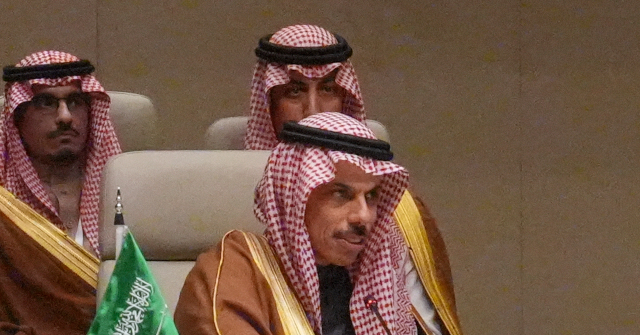
The government of Saudi Arabia held a large ministerial-level meeting in Riyadh with representatives of other victims of Iranian bombings in the past month, issuing a joint statement condemning Tehran for widespread drone and missile attacks on civilian sites in over a dozen countries.
Participating in the meeting were the foreign ministers of Bahrain, the United Arab Emirates (UAE), Egypt, Jordan, Kuwait, Pakistan, Turkey, Qatar, Syria, Azerbaijan, and Lebanon. On Thursday, the Saudi Press Agency (SPA) published a joint statement from the participants demanding an immediate end to bombings by Iran’s terrorist Islamic Revolutionary Guard Corps (IRGC) and warning Iran to stop disrupting commercial traffic in the Strait of Hormuz.
Iran has been at war with Israel and the United States since February 28, when President Donald Trump announced Operation Epic Fury to eliminate Iran’s ability to pose a threat to its neighbors. Iran is the world’s most prolific state sponsor of terrorism, funding the IRGC in addition to several other terrorist proxies including Hezbollah, Hamas, the Yemeni Houthi gangs, Palestinian Islamic Jihad (PIJ), and several Iraqi Shiite militias, among others. On the first day of Operation Epic Fury, Trump announced that an airstrike had eliminated the “supreme leader” of Iran, Ayatollah Ali Khamenei. America and Israel have eliminated dozens of senior Iranian leaders since.
In response to the military campaign, Iran has used its missile and drone capabilities to target its Arab and Muslim neighbors. Among the countries Iran has targeted, striking civilian areas, are many of the participants in the ministerial meeting late on Wednesday. Iran has also repeatedly targeted Israel and struck Cyprus. Iranian officials have denied targeting nations such as Azerbaijan and Turkey, though the IRGC has opened struck Saudi Arabia and the UAE, allegedly because they are not actively hostile towards America and Israel.
Following the meeting of Gulf Cooperation Council countries and other guests, the government of Saudi Arabia published a joint statement by the participating countries condemning Iran. The nations, according to the Saudi Press Agency (SPA), “affirmed their condemnation and denunciation of these Iranian deliberate attacks with ballistic missiles and drones which targeted residential areas, civilian infrastructure, including oil facilities, desalination plants, airports, residential buildings, and diplomatic premises.”
“The ministers further affirmed that such attacks could not be justified under any pretext or in any manner whatsoever,” the text continued, demanding Iran “immediately halt its attacks and affirm… the necessity of respecting international law, international humanitarian law, and the principles of good neighborliness.”
“The future of relations with Iran depends on respecting the sovereignty of states and non-interference in their internal affairs,” the countries warned, “as well as refraining from violating their sovereignty or their territories in any manner whatsoever, and not using or developing its military capabilities to threaten countries of the region.”
The joint statement concluded by discouraging Iran from blocking commercial traffic in the Strait of Hormuz and expressing concern about the ongoing Israeli invasion of Lebanon, which has displaced over 1 million people according to Lebanese officials.
During the ministerial meeting, Saudi Arabia’s top diplomat, Foreign Minister Prince Faisal bin Farhan, warned that, at the moment, he does not see a way to restore trust between Iran and its Arab neighbors in a status quo situation.
“What little trust there was before has completely been shattered,” Prince Faisal lamented. “So when this war eventually ends, in order for there to be any rebuilding of trust, it will take a long time.”
“If Iran doesn’t stop… immediately, I think there will be almost nothing that can re-establish that trust,” he added.
The foreign minister added that Saudi Arabia was willing to use “every lever” available to stop Iran from bombing it and rejected any pressure to restrain itself in defense of its citizens.
“We have reserved the right to take military actions if deemed necessary,” he added.
The government of Qatar, which suffered economically in the late 2010s after Gulf states organized a boycott in protest of its attempts to befriend the Iranian regime, announced late on Wednesday that it would expel all Iranian diplomats and shut down the Iranian embassy in Doha. The move was a response to Iran bombing the Ras Laffan Industrial City, a critical liquified natural gas (LNG) facility in Qatar. Reports described “extensive damage” at the site.
“The ministry explained that this decision comes in response to repeated Iranian targeting and the blatant aggression against the State of Qatar,” the Qatari Foreign Ministry explained, “which violated its sovereignty and security, in a flagrant breach of the principles of international law, United Nations Security Council Resolution No. (2817), and the principles of good neighborliness.”
“The ministry stressed that the continuation of this hostile approach by the Iranian side will be met with additional measures by the State of Qatar,” it added, “in a manner that ensures the protection of its sovereignty, security, and national interests.”