This article is part of Upstream, The Daily Wire’s new home for culture and lifestyle. Real human insight and human stories — from our featured writers to you.
***
Scrolling through social media can make you feel like the world has gone mad. But this month, that might be a good thing.
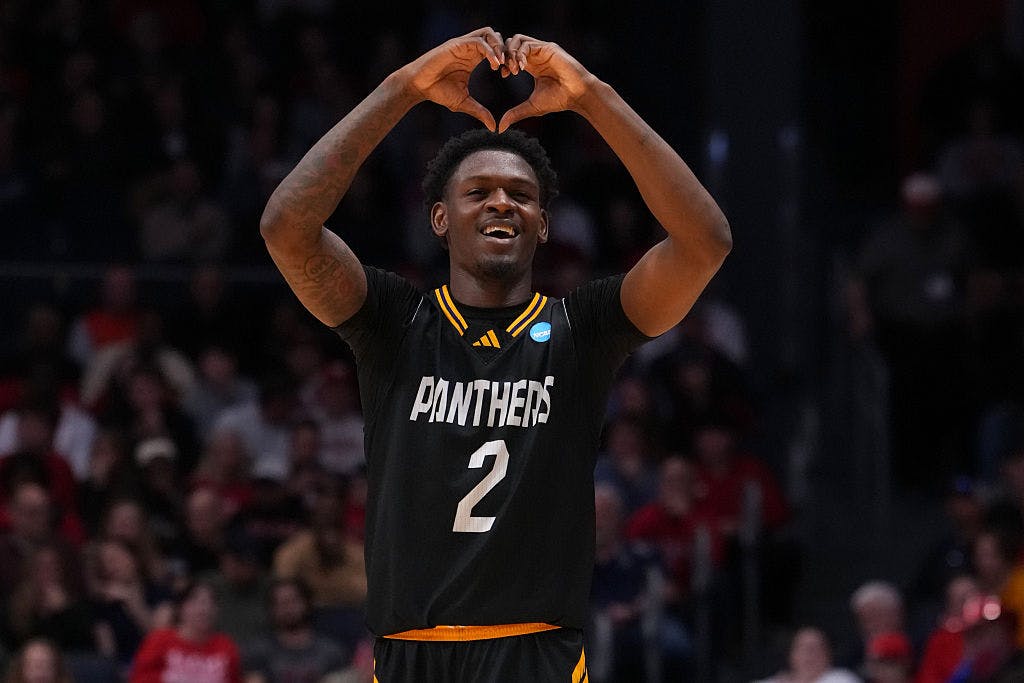
It’s officially the time of year when Americans come together to celebrate a very specific kind of madness: March Madness.
For the next three weeks, Republicans and Democrats will unite in their passion for the single-elimination, multi-week tournament competition between the top 68 National Collegiate Athletic Association Division I men’s college basketball teams, euphemistically known as “March Madness” or “The Big Dance.”
College basketball fans across the nation will come together this month to root for the underdog team, yell at referees when they make bad calls, and be amazed by the beautiful game of basketball.
Making it to “The Big Dance” is the fantasy of every kid who’s played basketball in high school, but it’s one that few achieve. Only 1% of male high school basketball athletes go on to play at the Division 1 level, and even fewer get the chance to play in the tournament. Stepping onto a March Madness court is a dream come true for college athletes, and teams play with a level of energy and heart rarely seen in professional sports.
Top-seeded teams have the advantage of playing lower-seeded teams in the early rounds, which should make their path toward the championship easier. But in basketball, when five players work hard and play as a unified team, they can defeat a team of more-talented superstars resting on their laurels.
The tournament is known for thrilling upset victories and Cinderella stories. You can anticipate, with reasonable certainty, that at some point during the tournament a low-seeded David is going to defeat a top-seeded Goliath in an epic, all-heart, buzzer-beating win. It’s complete madness. And that’s why it’s so fun to watch.
While most of us have never stepped foot on a college basketball court, we’ve found a way to feel like a March Madness winner by participating in the beloved tradition of “filling out a bracket.” This is the vernacular to describe trying to predict the outcome of all 63 single-elimination games played during the tournament. The NCAA has no verified record of a perfect bracket ever existing. The odds of completing a perfect bracket are estimated to be 1 in 120.2 billion, if you’re making educated guesses. Those odds worsen to 1 in 9.2 quintillion if you’re making picks based on a coin toss.
I started filling out a March Madness bracket as a 10-year-old in the ’90s, and, while I’ve never come close to perfection, I have a lot of happy memories of the process.Back then, you couldn’t instantly print a bracket on Sunday night when the tournament teams were announced. You had to wait until Monday morning, when the entire bracket was printed in a special March Madness edition of USA Today. My dad would come home from work that evening with a stack of special March Madness edition USA Today newspapers. As a college basketball-loving ’90s kid with no internet, I was thrilled to read that newspaper.
Every year, I’d watch the tournament with my dad. Looking back, I don’t remember many specific games, players, or winning teams during the hundreds of hours of basketball we watched. What I remember is being allowed to stay up way past my bedtime on a school night to watch the 1993 championship game. I remember my dad, a Villanova fan, retelling the story every year of when an 8th-seeded Villanova team won the national championship in 1985. I remember trash-talking my brother when the team he picked to win the entire tournament went out in the second round.
While I genuinely love basketball, the memories of being together with family and friends are the real reason I’m such a fan of the March Madness tournament. Sports create a shared experience and give us a reason to come together as families, communities, and Americans. This is as important as ever in today’s world, where we are chronically online and constantly reminded of the deep divisions in our nation.
And as we root for the underdogs this March, it’s worth remembering that America is the ultimate underdog story. Growing up in the Philadelphia suburbs minutes away from the location of George Washington’s famous 1776 crossing of the Delaware River, I’ve long viewed that night as one of the greatest underdog stories — even better than Villanova’s victory as an 8th-seeded tournament team.
Washington’s army was struggling, and morale was low when he led a group of battered soldiers to take on the polished Hessian troops stationed in and around Trenton, New Jersey. The Hessians severely underestimated Washington and his army, to their great peril. The American underdogs stunned the British-supporting troops and handed them a swift defeat during the Battle of Trenton that provided a critical boost for the fledgling nation. America has a history of defeating Goliaths and winning big, against all odds, when we work together to protect freedom and liberty.
As finding common ground becomes increasingly difficult, watching March Madness with a friend, a neighbor, or even a stranger might be the doomscrolling antidote America needs right now. When we gather to watch the tenacity, camaraderie, and excellence of top athletes competing this March, may we be reminded of our shared humanity that’s deeper than any political divide. The freedom to disagree is a hallmark of our democracy. May we work harder than any sports team out there to keep it.
***
The views expressed in this piece are those of the author and do not necessarily represent those of The Daily Wire.