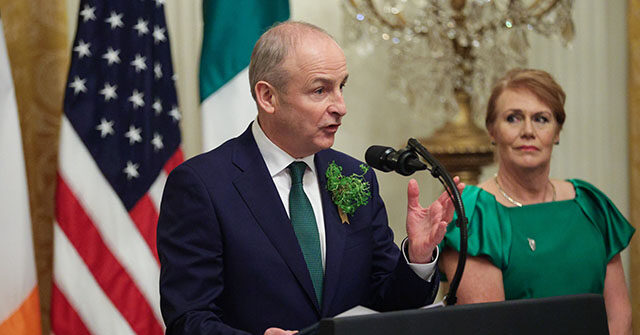
The Irish government used the St. Patrick’s Day celebrations as an opportunity to ask for an Irish migration path into U.S. jobs and homes.
Micheál Martin, Ireland’s Taoiseach, or prime minister, asked for the path when he met with President Donald Trump on Tuesday to celebrate Irish-U.S. ties:
In fact, I’d love if we could develop a legal pathway between the U.S. and Ireland into the future because of our [shared cultural] history … No-one is in favor of illegal immigration or so forth.
“Uh-huh,” Trump responded without further comment.
In 2018 and 2019, the Irish government lobbied Congress to open a white-collar migrant route via the E-3 visa. But the scheme was blocked by Sen. Tom Cotton (R-AR) amid close coverage by Breitbart News. The scheme stood little chance of success, mostly because many U.S. legislators and multiple diverse ethnic lobbies would treat the Irish plan as a bargaining chip in the national migration debate.
But Martin’s pitch for a new migrant path was largely lost amid media questions about the Persian Gulf, Russia, and other non-Irish topics. Those questions prompted Trump to slam Ireland’s and Europe’s strategy of economic growth via migration:
You’ve allowed millions and millions and millions of people to come into your country that shouldn’t be there … You’d better do something … or you won’t have a Europe.
Martin tried to defend Ireland’s rapid migration policy, which is largely driven by policies set in Europe.
Those European leaders recently announced plans to sideline Europeans by importing more low-wage workers from India and North Africa.
Since 2015, Ireland’s self-confident progressive class has imported so many migrants for business groups and the real estate industry that more than one-in-five residents of Ireland’s 5.2 million population are migrants.
The policy has boosted housing costs, drained government aid, diversified schools, fueled civic uproar, and crashed birthrates amid slow per-capita consumption growth.
The demographic replacement of the Irish is being accelerated as many Irish people emigrate in search of decent jobs.
The massive population shift is also helping progressives to attack Ireland’s Christian-based culture of citizen rule. This week, for example, Ireland’s largely powerless progressive president demoted St. Patrick to a secular Patrick in her annual address as she called for more migrants to flood into Ireland’s tiny population of just 4 million Irish.
Martin defended the pro-migration policies, telling Trump:
First of all, I would say that Europe is still a very good place to live. Our population is growing but in a very positive way. Our economy is going well because we’re attracting a lot of people from Europe and beyond into work, legally and validly, in our country … I think sometimes Europe gets characterized wrongly in terms of it being overrun, or whatever like that. It’s much more robust now [with a] much more stronger mechanism in place to facilitate legal migration.
Martin also told Trump that Vice President JD Vance urged him to invest in innovation and automation instead of immigration:
We need more economic growth in Europe. It doesn’t have the same focus on innovation as you do here in the U.S. [I] discussed that earlier with the Vice President. In terms of technology, in terms of AI, we need to pivot more to innovation, as opposed to regulation. And I think investing in people … is key.
Vance had earlier welcomed Martin to breakfast at the Vice President’s house in D.C.
The two shared a table with an Irish-born Silicon Valley entrepreneur, Patrick Collison, who has repeatedly slammed Trump’s pro-American immigration policies for restricting the inflow of white-collar workers. Collison and his brother launched a company called Stripe, which provides rapid processing of banking transactions.
Collison’s Stripe uses roughly 200 H-1Bs, has sponsored more than 1,500 migrant employees for green cards, and fired 300 unidentified employees in January.
Also sitting at Vance’s table was Sen. Markwayne Mullin (R-OK), the president’s nominee to take over the Department of Homeland Security. The department oversees the annual inflow of roughly 1 million legal immigrants. It also manages the inflow of roughly 500,000 new temporary migrants — via the H-12, J-1, L-1, TN, H4EAD, CPT, and OPT programs — seeking the white-collar careers needed by Americans.
The legalized white-collar inflow is increasingly unpopular with white-collar voters because it sidelines millions of Americans, cuts American salaries, and puts critical technology and companies into the hands of Indian workers, managers, and CEOs.
Vance has repeatedly warned European leaders against their policy of growing GDP with migrant consumers, renters, and workers, many of whom are both low-skilled and resentful of their lower status in Europe.
In December, Vance warned Europeans that their growth-via-migration economic strategy is wrecking their homeland:
[European] immigration policies have caused a significant backlash from the native population … I think that Europe doesn’t have a very good sense of itself right now, and you see that reflected in various measures of economic and cultural stagnation.
Martin, however, used the breakfast with Vance to tout the role of Irish migration to the United States:
Stripe’s success is a wonderful example of an Irish enterprise whose journey is built on investment in America. I can remember meeting young Patrick [Colison] as a young scientist at our [annual] Young Scientist exhibition when I was a minister for education, and he didn’t even hang around, he went straight to America. It is clear that the threads across the Atlantic that are woven through the rich tapestry of the United States remain strong.
Ireland has little diplomatic leverage over the United States, partly because its small economy is magnified by tax rules that invite U.S. companies to dodge U.S. federal taxes.
Trump’s business deputies are trying to expand a golf course in Ireland. But they are being delayed pending the local government’s approval of a protection plan for Ireland’s “narrow-mouthed whorl snail.”
Tuesday’s policy differences were largely buried under feel-good compliments about the role of the Irish in U.S. history.
“All of us in America, most of us, at least, have somebody who has this deep connection to that, that Ireland, that island on the other side of the Atlantic, and we love it, and we admired it, and we cherished the incredible friendships that we have and the great things that Ireland has done for the United States of America,” said Vance.
“Today is a very special start to what for us is an unforgettable day … as we gather to celebrate Saint Patrick’s Day 2026,” Martin told Vance.
The Irish Times newspaper admitted the hard-nosed reality behind the diplomatic greenery:
Much is made about the [Irish] Republic’s special access to the White House and the willing indulgence of a long line of US administrations regarding the State’s national day. All true, but it should be noted that in the Trump White House, heads of state roll through like customers in a busy Starbucks; Japanese prime minister Sanae Takaichi is here on Thursday.
By then, if things have gone to plan, the fabled bowl of shamrock will be somewhere in the White House, starting to wilt and likely half forgotten.