Faisal Islam,Economics editor,
Lucy Hookerand
Mitchell Labiak,Business reporters

 Getty Images
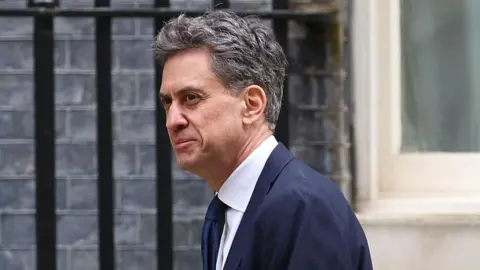
The government “will not tolerate” energy firms profiteering from the rising price of oil and the competition watchdog is primed to step in to prevent petrol price “rip-offs”, Energy Secretary Ed Miliband told the BBC.
Miliband did not rule out direct support or extending the freeze on fuel duty if the conflict continued, but opposition parties have accused Labour of failing to act.
The Petrol Retailers Association (PRA) said it would “counter any suggestions of profiteering” at a meeting between the industry and government later on Friday.
“We hope to engage constructively […] to ensure there is a clear understanding of how our industry works,” said Gordon Balmer, executive director of the PRA, which represents forecourt businesses.
He has previously said that surging wholesale oil prices “will mean pump prices will have to go up”.
Some energy companies and industrialists have argued that the response to the current oil price shock should be to allow further exploration and production in the North Sea.
However, in an interview with the BBC, Miliband said that the “right answer” for energy security as well as for tackling climate change was the government’s current strategy, to continue to produce oil and gas from currently operating fields, but not to permit new ones.
“New exploration licences in the North Sea, which some people are calling for, will not take a penny off people’s bills,” he said.
He also pushed back against calls to change tack on net zero, arguing the UK needed to get off the “fossil fuel rollercoaster”.
“We’ve got to have clean, homegrown power that we control,” he said. “That’s the biggest long-term lesson of this crisis.”
The government is under pressure to take action in both the short and long term on the threat of rising energy bills, as the effective embargo in the Straits of Hormuz, a crucial channel for energy supplies, continues.
Energy Minister Michael Shanks told the BBC: “The public expects us to take this really seriously.”
Miliband is launching a fast-track process for the building of new nuclear power stations, which in the past have been beset with delays, spiralling costs and red tape.
However, more immediate action may be required on rising petrol and heating oil prices.
The Chancellor, Rachel Reeves, and Miliband are due to meet petrol retailers later on Friday.
They will tell the industry that the Competition and Markets Authority (CMA) is on “high alert” for any unjustifiable price rises.
Earlier in the week the chancellor highlighted a variation in petrol prices between £1.27 per litre and £1.80 per litre on different forecourts.
Petrol retailers have said the price discrepancy is because some forecourts buy oil in bulk weeks in advance, meaning the surging oil price has not fed through to the pump yet, while others buy oil at the daily price, meaning the price is quickly feeding through.
Meanwhile, heating oil costumers have told the BBC their bills have more than doubled.
Households that use heating oil are mostly in rural areas not connected to the gas network.
Two thirds of households in Northern Ireland use heating oil, but only a minority of homes in England, Wales, and Scotland do.
There is no cap to limit the cost of heating oil in the way households benefit from regulator Ofgem’s price cap on gas and electricity bills.
Miliband said he and the chancellor were “really concerned” over what was happening in some parts of the market and had met the CMA earlier in the week to discuss heating oil and motor fuels specifically.
“They’re looking at the situation carefully. They are willing to intervene,” he said.
“We will not tolerate unfair practices, price gouging.”
The CMA has a range of powers including fines they can impose on firms.
“It’d be completely unacceptable for anyone to use this crisis, to rip people off,” Miliband said. “And we will fight people’s corner to stop that happening.”
However, whether the government took further steps to support households would depend on how long the conflict lasted, he added.
He emphasised that the chancellor had previously shown a “willingness to intervene”, a reference to moves in November’s Budget to ease energy bills, with additional money targeted at vulnerable households.
Fuel duty, which is currently frozen, is set to rise in September. That was now under review, Miliband confirmed.
Shadow transport secretary Richard Holden said Reeves “could cancel the fuel duty rise, she could cut the taxes piled on to energy, she could stop piling costs on to the price of fuel – but she isn’t doing anything because she doesn’t have the backbone”.
“A 5p-per-litre duty increase at the pump will hit commuters, families, and small businesses already under pressure from the cost of living and Labour’s tax hikes,” he added.
“The latest developments in the Middle East make it even more important that the chancellor thinks again,” Holden said.
Asked if the government had put the economy in a weaker price prior to the war, Shanks said: “I don’t accept that at all… and we’re also doing everything we can to get the economy moving.”