Order Jamie Glazov’s new book, ‘United in Hate: The Left’s Romance with Tyranny, Terror, and Hamas’: HERE.
Western democracies are in serious trouble—not because they are weak, but because they still refuse to understand the nature of the war being waged against them.
For decades, Western elites have insisted that conflicts involving the Muslim world are primarily about politics, economics, colonial grievances, poverty, or social injustice. They have explained away jihad as a reaction to circumstance rather than an expression of belief. But much of the Muslim world does not see the conflict that way at all. It sees it as religious, civilizational, and existential.
Until the West understands that reality, it will continue to misread the Middle East, misread jihadist movements, misread the radicalization spreading inside its own societies, and endanger its own future.
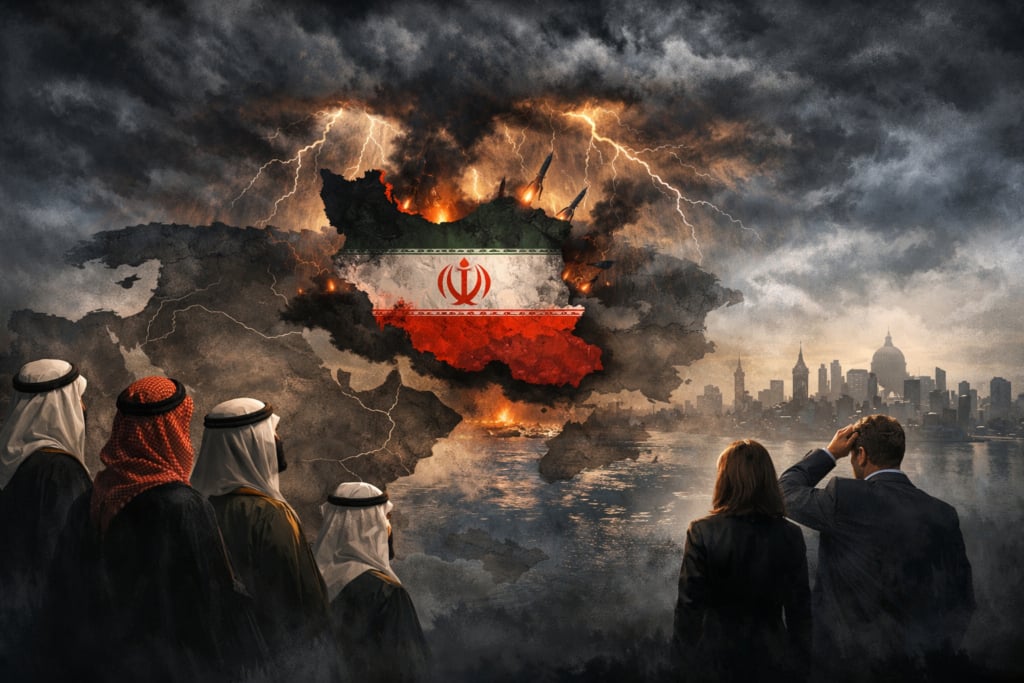
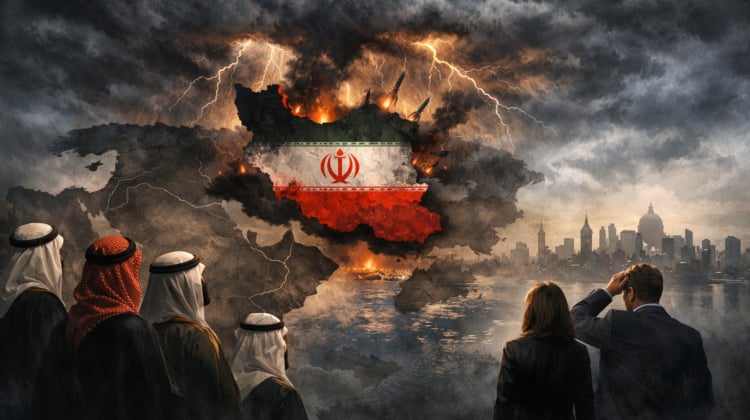
That misunderstanding is playing out in the war with Iran right now. The question Western analysts should be asking is simple: If Iran is attacking Arab Muslim countries too, why are those countries not joining the war to bring down the regime in Tehran? Iran’s aggression is not directed only at Israel. Arab states have watched for years as Tehran threatened the region through missiles, proxies, sabotage, and terror. And today, the Iranian regime is shooting rockets at their oil infrastructure, airports, cities, shipping lanes, and internal stability. And yet, despite all that, Saudi Arabia, the UAE, Qatar, Bahrain, Kuwait, and others are not publicly lining up beside Israel and the United States in a campaign to topple the Islamic regime.
To Western observers, this seems irrational.
It is not irrational. It is Islamic.
The Middle East does not operate according to the secular assumptions of Western foreign policy, and that is precisely where so many Western analysts go wrong. Muslim governments are deeply reluctant to publicly align with non-Muslims against another Muslim power. Western strategists tend to believe that states act only according to interests, but in the Middle East, religion is not a decorative detail. It is often the central organizing force. Sunni and Shiite regimes may slaughter each other, as we have seen in Syria, Yemen, Iraq, and Lebanon, but even when Muslim states are bitter enemies, there remains enormous resistance to being seen siding openly with Jews or with the Christian West against a Muslim state. That is not merely a political problem. It is a legitimacy problem. A ruler perceived as joining the infidel camp against fellow Muslims risks domestic backlash, clerical agitation, and being branded a traitor to Islam. So Arab regimes may cooperate quietly, share intelligence, or hope Israel and America do the job for them. Publicly, however, they remain silent.
There is another reality the West refuses to confront: many Sunni Arab regimes still fear the prospect of Israel emerging as the dominant regional power. Yes, Sunni and Shiite powers fight each other viciously. Yes, many Arab governments fear Iran more than they fear Israel. But that does not mean they are comfortable with a Middle East in which the Jewish state becomes the decisive military and strategic force in the region. Western policymakers imagine that shared interests erase older religious and civilizational realities. They do not. For many in the Muslim world, the idea that a non-Muslim state – especially a Jewish one – would become the region’s anchor power remains deeply humiliating and deeply unacceptable.
Israel poses no imperial threat to them. It is not trying to conquer Mecca or dominate the Gulf. In fact, Israel is the one regional power with the military, intelligence, and technological capabilities to help stabilize the region against Iran’s terror empire. But that is precisely the point. A weakened Iran is one thing. An ascendant Israel is another. And so Arab governments hedge. They may prefer Iran damaged, but they are not eager to help create a Middle East in which Israel clearly stands at the top of the strategic hierarchy.
The biggest reason, however, is fear; fear that America will once again stop the war before finishing what needs to be done.
The Middle East has watched the United States enter conflicts and then lose the will to finish them. Iraq. Afghanistan. Red lines declared and abandoned. Commitments made and diluted. Whether those withdrawals were justified from an American domestic perspective is beside the point. What regional governments learned was simple: America may start the fight, but it may not finish it. That is the nightmare scenario for every Arab regime now calculating its next move. If they openly join the war against Iran, then cave to media pressure, diplomatic pressure, or elite fatigue before the regime collapses, those Arab states will be left exposed beside a wounded but surviving Iranian regime bent on revenge.
That is not a theoretical concern; it is a very serious, sobering, realistic, and dangerous scenario.
Their calculation is brutally pragmatic: better to absorb the blows now than openly join the war and later face an enraged surviving regime alone.
This is the larger lesson Americans need to understand. Toppling the Islamic regime in Iran is not just about Israel, and it is certainly not about the stale fantasy that “the Zionists” are dragging America into someone else’s war. A post-regime Iran would also deal a major strategic blow to China, America’s biggest military and economic enemy. Beijing relies heavily on Iranian energy, Iranian alignment, and Iranian usefulness as an anti-Western node in the Middle East. Tehran helps China undermine sanctions, expand its regional footprint, and build an anti-American axis across key transit and energy corridors. The collapse of the Islamic regime would not only weaken jihadist terror; it would also strip China of one of its most valuable footholds in the region.
In other words, bringing down the regime in Tehran is not a favor to Israel. It is America First.
But the deeper issue goes beyond Iran. The West still refuses to grasp that much of the jihadist war against it is not fundamentally about borders, economics, or grievance narratives. Those are the packaging. The core is religious and civilizational. Both Sunni and Shiite jihadists understand this perfectly well. They speak the language of human rights when it helps them. They invoke victimhood when it is useful. They exploit democratic freedoms, multicultural guilt, legal protections, media cowardice, and elite confusion. But their long-term goal is not coexistence.
It is submission.
While Western elites keep arguing over terminology, jihadist ideology continues to spread across Europe and North America—city by city, institution by institution, school by school, and increasingly, office by office—exploiting open societies that still lack the moral clarity to recognize the threat.
The free world cannot afford to remain this naïve. This war cannot be stopped halfway. Stopping before the Islamic regime collapses would produce the worst possible outcome: a wounded but surviving Iranian regime, terrified Arab states forced back into submission, renewed Iranian expansion across the region, a stronger China in its strategic contest with the United States, and a global jihadist movement emboldened by yet another display of Western weakness.
That is not de-escalation. It is surrender by installments.
The war should end only when the Islamic regime is toppled and replaced. Anything less guarantees that the same threat will return, bloodier, bolder, and better positioned. Until that happens, much of the Arab and Muslim world will keep doing exactly what it is doing now: taking the hits, staying quiet, and watching to see whether America finally has the will to finish the job.
Avi Abelow, host of The Pulse of Israel daily video podcast and the CEO of the 12Tribe Films Foundation, which produces media content highlighting Israel’s biblical, historical, and strategic importance to the Jewish people and the world. He is the 2025 recipient of the Ari Fuld Project’s “Lion of Zion Award”.
In order to eliminate spam comments that have historically flooded our comments section, comments containing certain keywords will be held in a moderation queue. All comments by legitimate commenters will be manually approved by a member of our team. If your comment is “Awaiting Moderation,” please give us up to 24 hours to manually approve your comment. Please do not re-post the same comment.