Esme StallardClimate and science reporter

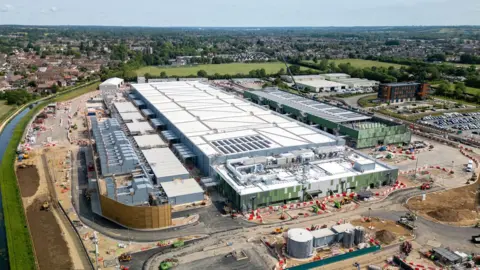 Richard Newstead/Getty Images
Artificial intelligence data (AI) centres could get priority access to the electricity grid under new government proposals to tackle soaring energy demands.
Currently all new infrastructure, from hospitals to industrial sites, must join a virtual queue to get an electricity connection.
In the first half of 2025 the queue grew by 460%, driven mostly by power-hungry data centres meaning some projects face waits of years to get up and running.
Under Wednesday’s proposals, projects which promise the most economic growth and jobs could jump the queue.
But the Home Builders Federation has warned failing to prioritise connections for housing developments would be an effective “moratorium” on new homes.
In November, the regulator for the energy sector Ofgem warned that the queue to get a supply of electricity had surged past “even the most ambitious forecasts for future demand” driven mostly by the demand from AI data centres.
And it warned that some of those projects in the queue were only “speculative” – even if they were given a connection they did not have enough financing, proper planning permission or land rights to lead to a real project.
The risk was that genuine projects, further behind in the queue but which could provide new jobs and local economic growth, were being blocked.
The government now plans to tackle that problem by prioritising those projects that offer the most economic development and job creation.
It will consult on allowing “strategically important” projects to skip the queue. These would include projects such as AI infrastructure, EV charging hubs and industrial sites looking to switch away from fossil fuels to electricity.
Simultaneously, Ofgem is looking at consulting on tightening up the rules to join the queue in the first place.
“Delivering data centres… relies on access to the grid. These timely reforms will help us move at pace, to seize AI’s potential to help build a wealthier and fairer Britain,” according to AI Minister Kanishka Narayan.
But the Home Builders Federation (HBF) raised concerns that new houses were not included as priority pieces of infrastructure.
“As we continue to face into a housing crisis it is frustrating that regulatory, planning and policy arrangements effectively prioritise energy intensive data centres over energy efficient homes for families,” said Steve Turner, executive director at HBF.
Data centres already receive preferential treatment in planning as they have been designated critical national infrastructure, meaning they can not be blocked by local objections.
Turner added that if housing wasn’t prioritised it would be an “effective moratorium on new homes in areas where capacity is constrained”.
London Assembly members warned in December this was already the reality being faced by parts of the capital.
There are nearly 500 data centres already dotted around the country helping to run digital services from banking transactions to online gaming, accounting for 2% of the country’s electricity demand.
But the growth of AI will increase the number of centres as more processing power is needed, and their electricity demand could increase by up to six-fold between now and 2050, according to the grid operator.