Katy Watsonand
Simon Atkinson,reporting from the Gold Coast

 AFP via Getty Images
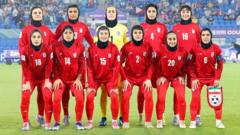
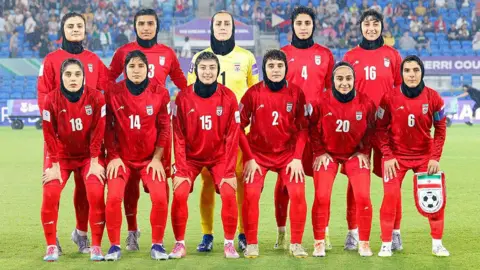
Five members of the Iranian women’s football team have taken refuge in a safe house in Australia following their elimination in the Asian Cup, sources have told the BBC.
The women had been due to fly home, but supporters had raised fears for their safety after the team declined to sing the national anthem ahead of their first match against South Korea last week.
This prompted criticism from within Iran, with one conservative commentator accusing the team of being “wartime traitors” and pushing for harsh punishment.
Hundreds of supporters surrounded the Iranian Lionesses’ coach as it left the stadium on the Gold Coast on Sunday evening, with chants of “save our girls”.
On Monday, the BBC witnessed dramatic scenes inside the team’s five- star hotel when several players left the lobby in a group after speaking to activists.
Shortly after they departed, a second group – including a translator and the head coach – burst in looking panicked, and rushed through the hotel before returning to their rooms.
Officials have not commented publicly.
However, a family member of one of the women – speaking on condition of anonymity – told Australian news site ABC they were being protected by police, and intended to claim asylum.
US President Donald Trump took to his Truth Social platform to demand action.
Australia should “give asylum” to the women, Trump said in his initial post.
“The US will take them if you won’t,” he added.
The Trump administration put all asylum decisions on hold at the end of last year, and has stopped issuing immigrant visas for citizens from dozens of countries including Iran. It has said the administration wants to bring “an end to the abuse” of the system.
Around an hour later, Trump posted again to say he had spoken to Australia’s Prime Minister Anthony Albanese and “five have already been taken care of, and the rest are on their way”.
Trump’s post appeared to also suggest some of the team feared for the safety of their families back in Iran and so felt they must “go back”.
“In any event, the Prime Minister is doing a very good job having to do with this rather delicate situation. God bless Australia!” Trump said.
‘They can’t speak freely’
Earlier, Craig Foster, a former captain of the Australian men’s football team and prominent human rights advocate, said activists all had “very reasonable and serious concerns for their safety”.
He told the BBC: “When any team participates in a Fifa-regulated tournament, whether Asian Football Confederation or any other confederation, they must have the right to safety and external support to express any concerns they have around their safety now or in future.”
In their second match against Australia and then again in Sunday’s final game against the Philippines, the Iranian team sang and saluted during the national anthem, leading critics to believe they’d been forced to take part by members of the ‘Islamic Revolutionary Guard Corps accompanying them as part of the delegation.
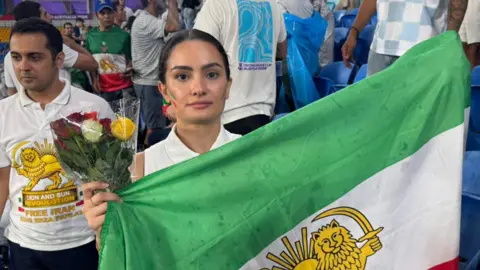
Deniz Toupchi, who travelled to support the team for their final match, said of the decision to initially stay silent: “We didn’t expect it to be honest because we know it’s a really major [thing] to do.”
She added: “We’re just proud of them.”
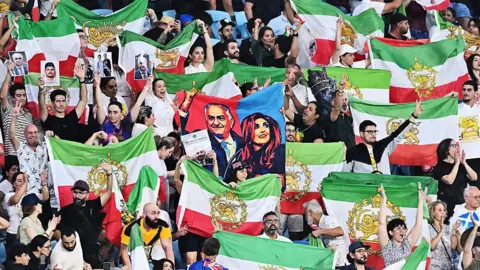
Toupchi was one of hundreds of members of Australia’s Iranian community in the stands on Sunday. During the anthem, which they do not recognise, they booed and jeered.
 Getty
Getty
Midway through the first half, many also unfurled the Lion and Sun flag, which served as the official state flag before the Islamic revolution in Iran. These had been snuck into the stadium in defiance of signs outside which said only Iran’s current official flag could be displayed.
But while the fans enthusiastically supported the players, there was very little interaction between them and the team during the match.
In one notable exception, a player receiving medical attention on the sidelines blew a kiss to the stands, receiving a huge cheer.
And while the Filipina team lined up to thank their fans at the end of the match, the Iranians left the pitch promptly.
“They can’t speak freely because they are threatened,” said Naz Safavi, who attended all three matches in which the team played. “We are here to show them that we are fully supporting them.”
With concern rising over the players’ treatment once they return home, there is a push to support the women to seek asylum in Australia, if they wish.
It’s unclear whether any player would want that – or, if they did, what repercussions there might be for their families as a result.
“They’ve been held hostage by the Iranian team management in their hotel and they’ve been denied the opportunity to speak to external community members, friends, family or any support networks, be that lawyers or anyone else,” said Foster, who played a key part in helping the Afghanistan women’s team flee the Taliban in 2021.
“Some may have concerns, others may not – but what we know is most of them have families back home, some of them have children back home, and even if offered the right to remain in Australia, if they feel unsafe, many of them may not accept that opportunity,” he says.
“What’s most important is that that offer is made.”
In Sunday’s post-match news conference, the team’s manager Marziyeh Jafari said: “We are impatiently waiting to return. Personally, I would like to return to my country as soon as possible and be with my compatriots and family.”
Australia’s government has so far resisted being drawn into the discussion.
“We stand in solidarity with the men and women of Iran, and particularly Iranian women and girls,” Australia’s Foreign Minister Penny Wong told ABC on Sunday, ahead of the match.
“Obviously this is a regime that has brutally cracked down on its people.”
As the players’ bus left the stadium on Sunday night, banners declared “Stay Safe in Australia. Talk to Police” and “If your home is not safe – mine is”.
Some supporters went further, evading police and trying to impede the vehicle’s progress through narrow roads around the stadium.
The players sat in the vehicle, watched the drama unfold in the rain outside. Some could be seen filming out of the window with phones. There were smiles and waves, but also solemn expressions.
At least one passenger could be seen closing curtains on the bus window.
 Supplied
Eventually, the bus made its way out onto the main road and towards the team hotel some 15 minutes’ drive away, leaving several supporters wailing and sobbing.
On Monday, there was tight security at the resort, with federal police stationed outside reception and no sign of the team, although some members of the Iranian delegation sat in the hotel’s communal areas.
It is not yet clear when the remaining players will check out and move – either to different accommodation, back to Iran or to a third country.
“The Australian government should play a [role of] moral leadership here,” said Zaki Haidari, Refugee Rights Advocate at Amnesty International Australia.
“It’s a very critical time as well as we celebrate International Women’s Day, talk about their freedom, equality, gender persecution, gender equality.”
That was a feeling echoed by the fans on Sunday night at the stadium.
“We are encouraging them, hoping they will stay here but at the same time we know their families’ lives are in danger,” said Melika Jahanian.
“Whatever decision they make it’s going to be a terrible one so they need to be supported by the Australian government.”