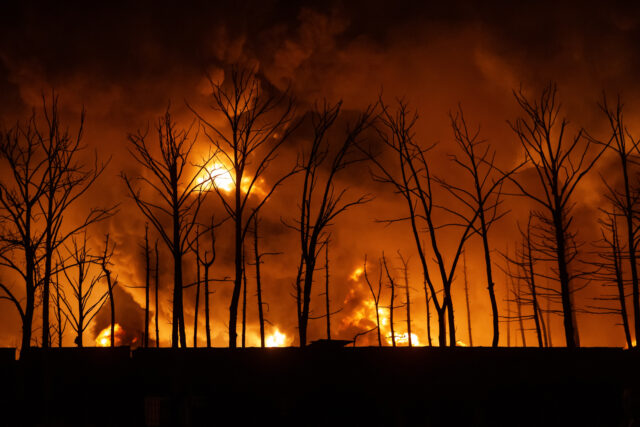
Oil prices surged past $110 a barrel on Sunday evening, topping $100 for the first time in nearly four years, as the war in the Middle East entered its ninth day with no end in sight and the Strait of Hormuz remained effectively closed to tanker traffic.
Brent crude, the international benchmark, briefly topped $110 soon after markets opened Sunday evening, while West Texas Intermediate rose to $109.05. Both benchmarks were trading around $60 a barrel in early January.
President Trump on Sunday night sought to reassure Americans that oil prices would come down in short order.
“Short term oil prices, which will drop rapidly when the destruction of the Iran nuclear threat is over, is a very small price to pay for U.S.A., and World, Safety and Peace. ONLY FOOLS WOULD THINK DIFFERENTLY!” Trump said on Truth Social.
The surge follows a record weekly gain last week — Brent climbed 30 percent, its biggest weekly jump in six years — as the conflict that began with U.S. and Israeli strikes on Iran on February 28 has choked off a waterway that normally handles about one-fifth of the world’s oil supply.
The Hormuz closure is now forcing producers across the Gulf to throttle back output as onshore storage fills. Iraq has cut production by roughly 60 percent, to between 1.7 and 1.8 million barrels a day from about 4.3 million before the conflict, according to reports. Kuwait declared force majeure on oil exports over the weekend, and Abu Dhabi has begun trimming output at offshore fields as well. Saudi Arabia, meanwhile, is racing to reroute crude shipments to its Red Sea port of Yanbu via its East-West pipeline, though it lacks sufficient loading capacity and tankers there to fully compensate, Bloomberg News reported.
Stock futures indicated the Dow Jones Industrial Average and the Nasdaq composite were set to drop 1.9 percent on Monday.
American drivers are already feeling the impact at the pump, with the national average for a gallon of regular gasoline rising about 16 percent since the war began, to $3.45, according to AAA. Diesel prices have climbed even faster, up about 22 percent.
Energy Secretary Chris Wright sought to calm markets on Sunday, telling CNN that the world is not short of oil and that disruptions to shipping through the strait would last weeks in the worst case, not months. Trump, speaking Saturday, was similarly dismissive of the price spike. “This is an excursion,” he said. “We figured oil prices would go up, which they will, they’ll also come down, they’ll come down very fast.”
The administration announced Friday that it would provide up to $20 billion in maritime reinsurance for vessels operating in the Persian Gulf. But shipowners say insurance costs are not their primary concern — they want full naval escort or an end to hostilities before risking their crews in the strait.
Analysts are warning that prices could go still higher. Goldman Sachs said Friday that crude and refined products could hit all-time highs if Hormuz flows remain depressed through March. Brent’s record stands at $147.50 a barrel, set on the eve of the 2008 financial crisis — equivalent to roughly $218 in today’s dollars.
The effects are being felt most acutely in Asia, which relies heavily on Gulf supplies. In Japan, which imports more than 90 percent of its crude from the region, refiners have asked for access to national oil reserves. China has curbed fuel exports to protect domestic supply, and South Korea is considering reinstating an oil price cap for the first time in 30 years. The leading index of Australian stocks fell 3.5 percent on Monday morning. Japan’s Nikkei plunged by more than six percent.