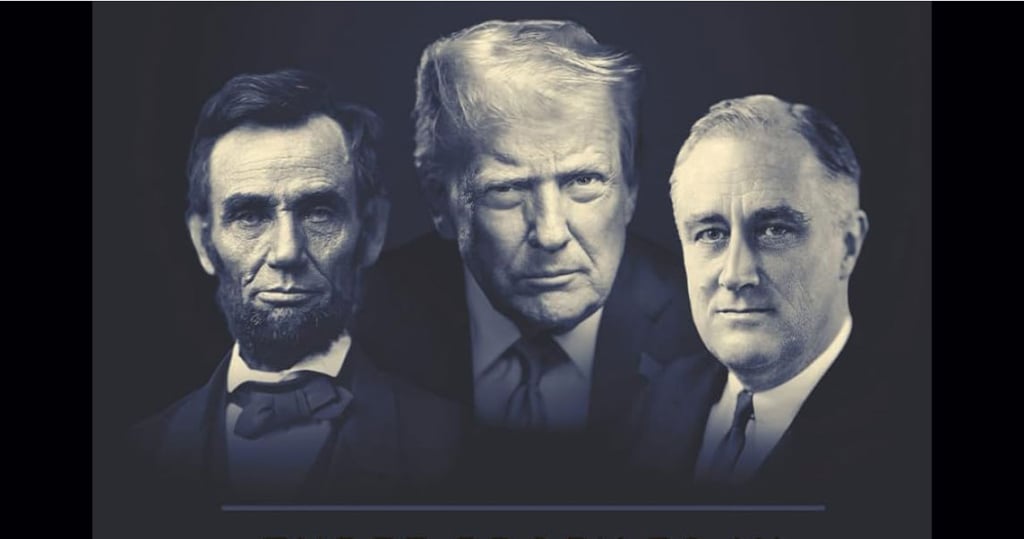
These days, non-fiction book titles – and subtitles – can be extremely hyperbolic, promising a great deal more than they deliver. But the title of Lee Harris’s Lincoln, Roosevelt, Trump: Three Profiles in World-Historical Leadership actually undersells the contents. For this isn’t some lazy rehash of three presidencies: it’s one of those exceedingly rare books that take on a huge swath of history – in this case, American history from the Puritans to the present – and, by tracing one or more recurring patterns, clarify, to a remarkable extent, the social, economic, and political developments of recent years. Even those of us who’ve made a career of examining these developments carefully, and who’ve reflected upon some of the historical parallels that Harris adduces, haven’t done anywhere near as elegant and thorough a job of putting it all together as he does.
In particular, as his title indicates, Harris foregrounds the likenesses among Lincoln, FDR, and Trump that make all three of them “world-historical figures” – a label, borrowed from the philosopher Georg Wilhelm Friedrich Hegel (1770-1831), that has a specific meaning. It doesn’t just mean great person – or unusually virtuous person. It means someone – Hegel’s own paramount example was Napoleon – who, challenging establishment norms, brought about significant and lasting changes in the world. Yes, several presidents other than Lincoln, FDR, and Trump made significant differences as well, and Harris gives them their due: Washington, by leaving office after two terms, established an invaluable precedent; Jefferson, by purchasing Louisiana, took the first step toward America’s transformation into an unconquerable transcontinental empire; and Jackson, by robustly wielding his veto power and closing the national bank, strengthened the power of the executive, thereby making it easier for Lincoln, decades afterwards, to do what was necessary to save the union.
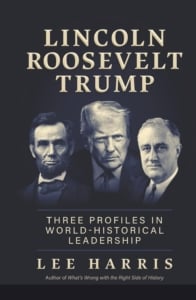 But for all their importance, even Washington, Jefferson, and Jackson, by Harris’s reckoning, weren’t quite world-historical figures in the same way as Lincoln, FDR, and Trump. For all three of these later presidents, explains Harris, “led populist revolts against the rise of a would-be ruling class. All three lived at a time when government by the people was on the verge of becoming a lost cause. All three believed that they were fighting to keep democracy alive not only in their own nation but in the world as well. All three, in short, faced epochal crises.”
To understand what these men accomplished, one must grasp what, from the beginning, has made America different from Europe. When we declared our independence, Europeans were ruled by kings; even now, when Europe’s countries are at least nominally democracies, their leaders are almost always drawn from a select elite. Similarly, America’s first six presidents, from Washington to John Quincy Adams, were members of our own upper crust – although Jefferson, in Harris’s words, was more of a self-conscious “tribune of the people” than the others.
But our seventh president, Jackson, was a genuine outsider, installed in the White House by a long-delayed electoral revolt in which ordinary people said no to government by the privileged. American politics, notes Harris, have been defined ever since by an alternation in power between elites and populists. And how has that been possible? Well, for one thing, while a great many Europeans, in modern times, have been preoccupied with ideology – which makes populism problematic – Americans (until recently) weren’t. For another, in parlous times, remarkable figures – Lincoln, FDR, Trump – have appeared on the scene, prepared to do everything necessary to save the day.
And they’ve done this against massive opposition from within the political establishment. Like Trump, Lincoln and FDR were in their time “despised by their political enemies (and even their allies)” and “routinely accused of aspiring to be dictators and tyrants.” Like Trump, they were not ideologues or utopians but “pragmatic opportunists.” And like Jefferson before them, taking it upon himself to purchase the Louisiana Territory, both also exceeded their constitutional powers in order to rescue the Republic.
First, Lincoln. His supreme goal was to save the Union, because he recognized it as “the last best hope of earth.” A world without America – even an America that was half slave and half free – would be a world without any freedom at all, and without even the hope of freedom. As Trump has had to fight both the Democrats and the never-Trump Republicans in order to get done the things he knows need to get done, Lincoln was at odds from the start with not only the Southern aristocracy but also the Northern establishment.
From the moment he took office, moreover, he faced a dual constitutional conundrum: first, there was nothing in the Constitution to forbid a state’s secession; second, the Constitution didn’t give the federal government the power to make war on American states. Many members of the northern elite, such as Horace Greeley, newspaper magnate, and William Henry Seward, Lincoln’s Secretary of State, thought the South should be allowed to leave. But Lincoln, knowing that he “could either preserve the Constitution or save the Republic,” but not both, chose to save the Republic. And no one but he, Harris contends, “could have led the North to victory,” because the common folk recognized in him not some snob who viewed them as deplorable but as a man of the people, sincerely devoted to their welfare. Sound familiar?
Then there’s FDR. I’m no fan. The New Deal didn’t end the Great Depression; it prolonged it. Going into this book, I certainly wasn’t thrilled with the idea of likening FDR to Trump. But Harris’s take is worth attending to. “FDR, like Lincoln,” he writes, “faced an epochal crisis—not a civil war, but the Great Depression. Unlike normal crises, there was no rule book for how to fix the collapse of the world’s economy. The finest economists of his time had not a clue.” Well, a lot of economists, then and now, have argued that things would’ve gotten a lot better a lot faster if FDR had done nothing – or at least done a lot less. Even Harris acknowledges that a Coolidge re-election in 1928 might very well have prevented the Great Depression altogether. But he also believes that by the time of the 1933 banking crisis, Coolidge’s laissez-faire approach was a non-starter. FDR, he insists, had to do something.
So what did FDR do? He expanded the federal government, of course, concocting New Deal schemes that “provided jobs only to Democratic loyalists, without doing much of anything to improve the national economy.” There was more. With Stalin, “he was at best criminally naïve, as in his decision to include the USSR as a permanent member of the Security Counsel [sic] of the United Nations, convinced of Stalin’s pacific intentions once the war was won.” He interned Japanese-Americans – an action that J. Edgar Hoover, no less, vigorously opposed. And he “sowed the seeds of an administrative bureaucracy far more liberal than the ordinary Americans it was administering, with portentous consequences for the future.” In other words, he gave us the Deep State.
Both Lincoln and FDR, then, “used the presidency to achieve purposes that were, at best, constitutionally doubtful and, at worst, morally and ethically wrong.” But both, in Harris’s estimation, count as world-historical figures, because, “under the most trying and desperate challenges ever faced by the leaders of any nation,” they “stayed true to the promise of the American Revolution,” fighting to preserve government of the people, by the people, and for the people and affirming the idea that the state should “promote the aspirations of ordinary Americans,” not crush them. Even FDR managed to retain “the basic principles of American exceptionalism” at a time when many purported wise men wanted America to turn fascist or Communist”; by dismissing both sides, FDR ensured that the postwar U.S. was “the leading nation of the free world.” While I’m not sure exactly how I feel about every detail of Harris’s analysis, I must say that he makes the best argument for FDR that I’ve ever seen.
Which brings us to Trump. “Hegel,” Harris reminds us, “believed that world-historical figures could only arise during an epochal crisis, when a dying old order gave way to a new one.” The present crisis developed because affluent elites with college diplomas came to believe in their own right to rule over the“deplorable” majority – government by the people, of the people, and for the people be damned. Under Bush Jr. and Obama, soi disant experts and intellectuals began to forge American policy as never before. Ideology took center stage. The advisors who talked Bush into the Iraq invasion seriously thought it would convert the Middle East to Jeffersonian democracy. Obama’s crew, abandoning traditionally liberal constituencies and policy priorities – and acting in collusion with the news media, Hollywood, and the academy – promoted issues to which ordinary Americans were either indifferent or hostile, from climate change and transgender ideology to mass immigration and the exportation of jobs to Mexico and China.
The “first stirrings” of a mass response to this agenda was the Tea Party movement of 2009. Then, in 2015, came Trump, whom both the establishment left and right recognized as a threat to their power. After his election in 2016, his enemies went all-out to bring him down. Then came 2020. Harris tiptoes around the controversy, but I’ll say it: the election was stolen. While criticizing the people who strolled the halls of Congress on January 6, 2021, as “fools” (I’d quibble with that word), Harris firmly – and quite properly – refuses to call what they did an “insurrection.” (Most of those imprisoned for their actions on that day, he points out, spent more time behind bars than Jefferson Davis and Alexander Stephens did after Appomattox.) When Trump was re-elected in 2025, leftists called it “a revival of European fascism.” In fact, as Harris puts it, it was “a revival of the principles of American exceptionalism just at the point when they appeared to be vanishing under the heavy hand of a corrupt and incompetent would-be ruling class invincibly convinced of its own inherent virtue.”
For Harris, the bottom line with Trump is that, like Lincoln and FDR before him, he’s championed the best of what makes America unique in the face of attempts to remake the nation wholesale. He’s fought off globalism, brought back pragmatism, and repudiated ideology. Consistently, he’s put his own country first. While he passionately seeks world peace, he’s no Wilson-style utopian, believing that the key to peace is diplomacy. Thus far, as Harris quite rightly observes, Trump’s approach has worked spectacularly. If it continues to do so, and if it can continue to spread around the world, “it will be a singular triumph, definitely putting him among the world-historical leaders who have most benefited humanity.” Indeed, if “FDR saved capitalism from itself,” Harris suggests, it may well turn out that Trump “saved liberalism from itself,” putting together a populist movement that, instead of descending into reaction and racism, is a model of real liberalism, devoted to individual liberty and indifferent to identity labels. Meanwhile the so-called liberals who sought to bring him down were using methods that would have brought a blush to the cheeks of the lowest Tammany Hall hack.
Naturally, it’s too early to conclude that the changes Trump has brought about will last. But as Harris puts it, if he “keep[s] the essence of American exceptionalism alive for even one more generation, rather than allowing it to be crushed by a corrupt and overbearing elite, he has already achieved enough to make him the only candidate for the position of the world-historical leader of our own time.” That’s for sure. And in this superb, consistently engaging book, Lee Harris has elucidated with uncommon insight not only the historic nature of Donald Trump’s achievements but also the broad historical panorama into which his presidency so fascinatingly fits.
In order to eliminate spam comments that have historically flooded our comments section, comments containing certain keywords will be held in a moderation queue. All comments by legitimate commenters will be manually approved by a member of our team. If your comment is “Awaiting Moderation,” please give us up to 24 hours to manually approve your comment. Please do not re-post the same comment.