

Katya AdlerEurope Editor
 BBC
BBC
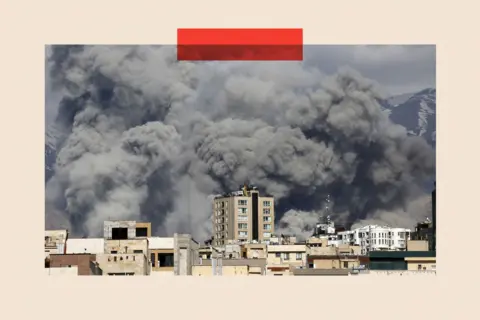
Europe knew this may be coming. For weeks, leaders and policy makers watched the US military build-up in the Middle East. They heard the threats of the Trump administration to Tehran: Give up all nuclear aspirations – or else!
But since the US-Israeli attack started on Iran three days ago, this continent has looked at best uncoordinated, if not fractured and decidedly without leverage, caught up in the maelstrom of events.
Each European country is understandably angsting about its citizens in the region – whether and how they may need to evacuate what would be tens of thousands of people in total.
European governments worry too about the impact the unfolding Middle East crisis may have on consumers back home. On energy and food prices, for example. European gas prices have soared to an extent not seen since the launch of Russia’s fullscale invasion of Ukraine in 2022.
 Getty Images
Politically, Europe is clearly struggling to find a united voice on the fast-paced dizzying developments in the Middle East.
The continent’s Big Three, France, Germany and the UK, did manage to issue a joint statement at the weekend, warning Iran they were ready to take “defensive action” to destroy its ability to fire missiles and drones unless Tehran stopped its “indiscriminate attacks”.
Since then, the UK has agreed to a US request to use two British military bases for “defensive” strikes on Iranian missile sites – although president Trump has been critical that the UK hasn’t been more active. France is bolstering its Middle East presence after an Iranian strike hit a French base in the United Arab Emirates and Germany says its soldiers remain ready for “defensive measures” should they be attacked but nothing beyond that was being planned.
All three countries stopped short of questioning the legality under international law of the US-Israeli strikes. Querying Washington was also conspicuously absent from the raft of tweets the EU’s foreign policy chief, Kaja Kallas, has been posting.
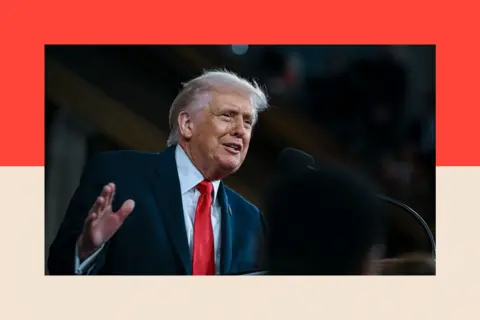
A top consideration of all these European leaders is not wanting to alienate Donald Trump. They desperately hope events in the Middle East will not be another distraction for the US president, preventing him – again – from engaging in finding a sustainable solution to another conflict, this one on their own continent: Ukraine.
But does the evasiveness of some leading European powers about the legality of recent US actions in Iran or Venezuela for example, muddy the waters? They often say this is a Europe of common values, that respects a rule-based international order. But what what exactly are the rules?
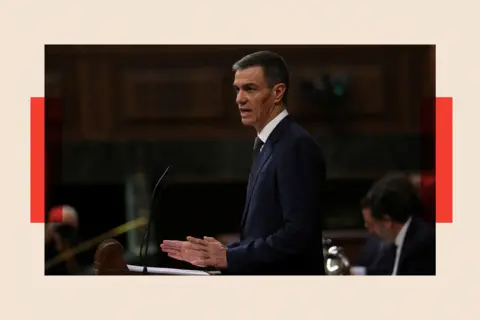
Spain’s prime minister says he’s clear. Pedro Sanchez took to social media, proclaiming “one can be against a hateful regime, as is the case with the Iranian regime… and at the same time be against an unjustified, dangerous military intervention outside of international law”.
A number of US aircraft left Spain on Monday after Madrid said those bases could not be used for attacks on Iran.
Meanwhile, the European Union has appeared totally uncoordinated. A statement by member states’ foreign ministers stopped short of advocating regime change in Iran, while the president of the European Commission (the EU’s main executive body) did just that on Sunday. “A credible transition in Iran is urgently needed,” its president Ursula von der Leyen said in a social media post.
 Getty Images
This was hardly a show of speaking with one voice.
And yet the declared ambition of European nations, in and outside the EU, including the UK – in this new, turbulent world of Big Power politics – is to work better together in areas of mutual interest, first and foremost in the arena of security and defence.
But the question is, are they really capable of doing so?
A nuclear shift
The year 2026 has truly been one of turmoil: Venezuela, Greenland and Iran. Europe faces an expansionist Russia on its doorstep, an economically aggressive China and an increasingly unpredictable ally in Washington.
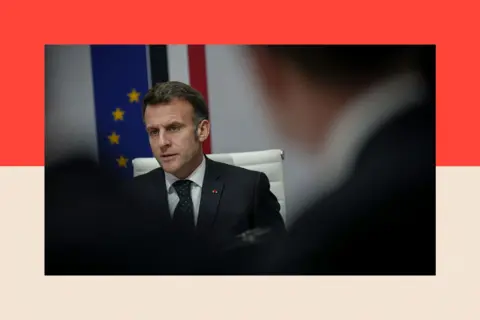
On Monday, President Emmanuel Macron announced that France would be changing its nuclear doctrine and increasing its number of nuclear warheads, because, he said, “our competitors have evolved, as have our partners”.
 AFP via Getty Images
Russia has the world’s largest nuclear arsenal, China is rapidly expanding its capabilities and while the US – the second-biggest global nuclear power, just behind Russia – has for decades provided Europe with a nuclear umbrella, changing priorities in Washington have made Europeans nervous.
Sweden, Germany and Poland have directly approached France to ask for wider European cover on top of the protection already offered to Nato allies by the UK, the only other nuclear power in Europe.
President Macron finds himself in the I-told-you-so position of having urged Europe for years to become more strategically autonomous in defence (including a big push into space, with dual-use satellites, for example, via the European Space Agency, of which the UK too is a member).
But coordination remains a huge challenge. Weapons procurement is a glaring example. While the United States employs around 30 different weapon systems, Europe has an often duplicated 178. “Inefficient, expensive and slow,” was the damning conclusion last week of the President of the European Parliament, Roberta Metsola.
 AFP via Getty Images
Nato is trying to mitigate this by attempting to manage acquisition decisions across its 32 members but the problem here is that the defence alliance’s guidelines are voluntary only. All Nato members (except Spain) bowed to pressure from Donald Trump last year and agreed to ramp up defence spending. But of equal importance is whether that money is then spent effectively.
The instinct of most national governments is to protect their own defence industries, even at the expense of their neighbours. France is often accused of this.
Priorities shaped by history
As unfolding events in the Middle East throw into sharp relief, each country on this continent has its own priorities, strengths and weaknesses, shaped by its history and voter concerns.
The fact that Germany felt the need to spell out very clearly this week that it does not plan to boost its military presence in the Middle East, never mind take part in any offensive action, comes down to the fact that Germans are still very conflict-shy, largely based on their country’s past.
Remember how Germany was initially ridiculed and berated internationally for being slow to send tanks to Ukraine after Russia’s full-scale invasion began four years ago? Then-German Chancellor Olaf Scholz was not displeased at all to be given the nickname “Friedenskanzler” (Peace Chancellor) in the German press. A large section of German society was initially deeply uncomfortable with the idea that German weaponry could be turned on Russians once again, as it had been during the two world wars last century.
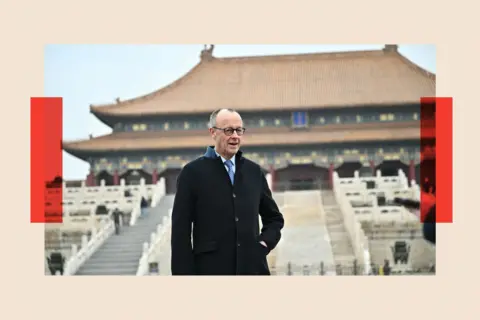
While still mindful of national sensitivities, the new German government of Friedrich Merz is going in a very different direction. It is now the single largest single donor of military aid to Ukraine.
 AFP via Getty Images
Like the rest of Europe, Germany leant on the United States for its security for decades. But with the Trump administration insisting that Europe now take over the lion’s share of its own defence, Germany plans to spend more on its defence budget by 2029 than France and the UK combined, according to Nato.
It wants to build the largest conventional army in Europe, too – and 80 years after World War Two, and with Germany firmly entrenched in Nato and the EU, fellow European powers are welcoming the German military initiative, rather than seeming threatened by it.
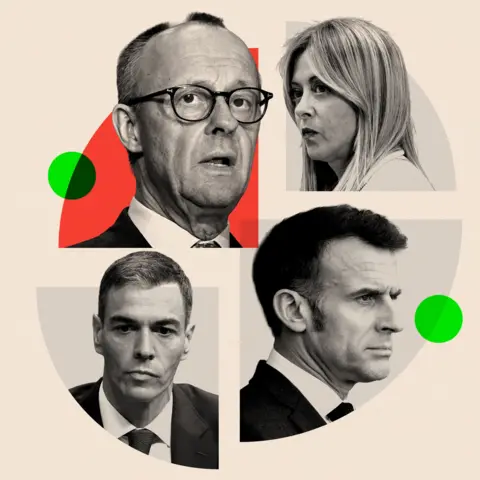
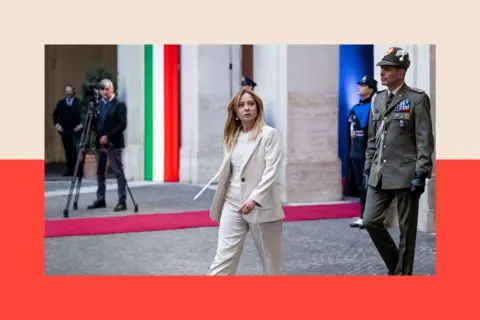
Italy’s prime minister, by contrast, is having to perform the most excruciating dance – between Italian voter opinion and what she believes is in her country’s and her own best interest on the world stage. So far, Giorgia Meloni has kept a very low profile on the US-Israeli attacks on Iran. She is one of the few leaders in Europe to have a truly warm relationship with Donald Trump.
As the third biggest economy on mainland Europe, you would expect Italy to play a prominent role in continental security. But until recently, it ranked amongst the lowest defence spenders in Europe. You have to take a look at Italian history to understand why.
Italy was only unified in 1861. Before that, it was considered a “battleground of Europe”, with foreign powers repeatedly exploiting its territories. Italians learned to rely and trust only the very few, rather than “the state”, to look after them.
Italy stood out in western Europe when Russia launched its full-scale invasion of Ukraine. It was the only country where, right from the start, a majority of the population opposed sending weapons to help Kyiv.
 Getty Images
Italians said they sympathised with Ukrainians but many questioned Italy’s involvement in the conflict. They simply didn’t trust their government to protect them from knock-on effects, like rising energy prices or potential reprisals by Russia.
Four years on, only 15% of Italians say they believe the EU and US should continue to arm Ukraine until Russian forces are driven out, according to the Institute for the Study of International Politics.
That’s why Italy’s staunchly Ukraine-supporting prime minister is in a very uncomfortable position. Her big pledges to international allies when it comes to defence are out of sync with the majority of Italian voters. Most Italians also oppose Giorgia Meloni’s pledge to her friend in the White House to boost defence spending significantly.
Ad-hoc coalitions
Being aware of allies’ national tensions, and therefore where they can, or can’t, fully be depended upon is key as Europe enters a self-declared era of closer cooperation.
The difficulties of acting “as one” , as we now see again over the Middle East, are giving rise to smaller ad-hoc coalitions of countries forming for mutual convenience around different issues: joint defence procurement projects such as the recent UK-Norway Defence Pact to track Russian submarines in the north Atlantic, or the Coalition of the Willing for Ukraine, led by the UK and France, for example.
Increasingly these “European” or Western alliances include what are described as like-minded nations from outside the continent, such as Canada, South Korea and Japan, which are often now included in Nato military exercises too.
Feeling squeezed by the new global climate where Might is Right, or at least Might takes centre stage, the family of nations for European cooperation is widening. But so is the challenge to understand what makes each family member tick, and whether they can work together effectively.
The first episode of Europe on the Edge with Katya Adler airs on 3 March on BBC2 at 9pm

BBC InDepth is the home on the website and app for the best analysis, with fresh perspectives that challenge assumptions and deep reporting on the biggest issues of the day. Emma Barnett and John Simpson bring their pick of the most thought-provoking deep reads and analysis, every Saturday. Sign up for the newsletter here