
 Getty Images
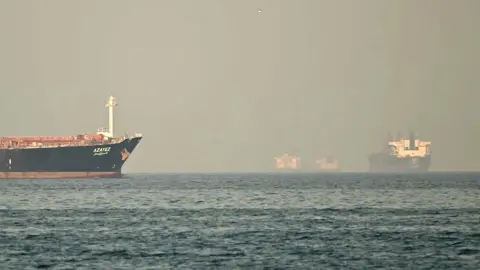
At least two ships have been hit by unknown projectiles near the Strait of Hormuz, as Iran continues to launch strikes across the Middle East in response to an ongoing attack against it by the US and Israel.
One vessel sailing east of the vital trade route was struck, while another was hit off the coast of the United Arab Emirates but planned to continue its journey, the UK Maritime Trade Operations Centre (UKMTO) added.
Iran has warned ships not to pass through the strait, which carries about 20% of the world’s oil and gas.
International shipping is said to have come to a standstill at the strait’s entrance, with fears of disruption already pushing up global oil prices.
While markets will not open until 01:00 GMT, so-called over-the-counter trades between private buyers suggest the price of Brent crude – the international benchmark – has jumped by around 10% to $80 (£59) a barrel.
Some analysts have warned it could go over $100 in the event of a prolonged conflict.
The UKMTO did not identify any of the vessels that had been hit.
But unnamed maritime security sources told the news agency Reuters that a Marshall Islands-flagged oil tanker had been damaged off the coast of Oman.
Iranian state television said an oil tanker was sinking after it was struck while attempting to “illegally” pass through the Strait of Hormuz. The BBC has not been able to verify this claim.
Iran and Israel launched fresh aerial attacks against each other on Sunday, after US-Israeli strikes killed Iran’s Supreme Leader Ayatollah Ali Khamenei on Saturday and prompted retaliatory strikes on several countries in the Middle East.
Strikes have been reported in Dubai in the UAE, Qatar’s capital Doha, Bahrain, and Kuwait.
In the midst of these attacks, dozens of ships have stopped moving to avoid the strait. At least 150 tankers have dropped anchor in open Gulf waters beyond the Strait of Hormuz, although a handful of Iranian and Chinese vessels have passed through today, according to ship-tracking platform Kpler.
‘The Strait is effectively closed’
“Because of Iran’s threats, the strait is effectively closed,” Homayoun Falakshahi from Kpler told BBC News.
“The vessels have taken a precautionary measure not to enter as the risks are too high and their insurance costs have sky-rocketed.”
He said the US would likely try to protect the strait which, if effective, would prevent an oil price spike, but if it remained shut for a long period prices could go “much, much higher”.
On Sunday, the Opec+ group of oil producing nations – which includes Saudi Arabia and Russia – agreed to increase their output by 206,000 barrels a day to help cushion any price rises, but some experts doubt this would help much.
Edmund King, president of the AA, warned the disruption could drive up petrol prices around the world.
“The turmoil and bombing across the Middle East will surely be a catalyst to disrupt oil distribution globally, which will inevitably lead to price hikes,” he said.
“The magnitude and duration of pump price increases depends on how long the conflict goes on.”