Order Jamie Glazov’s new book, ‘United in Hate: The Left’s Romance with Tyranny, Terror, and Hamas’: HERE.
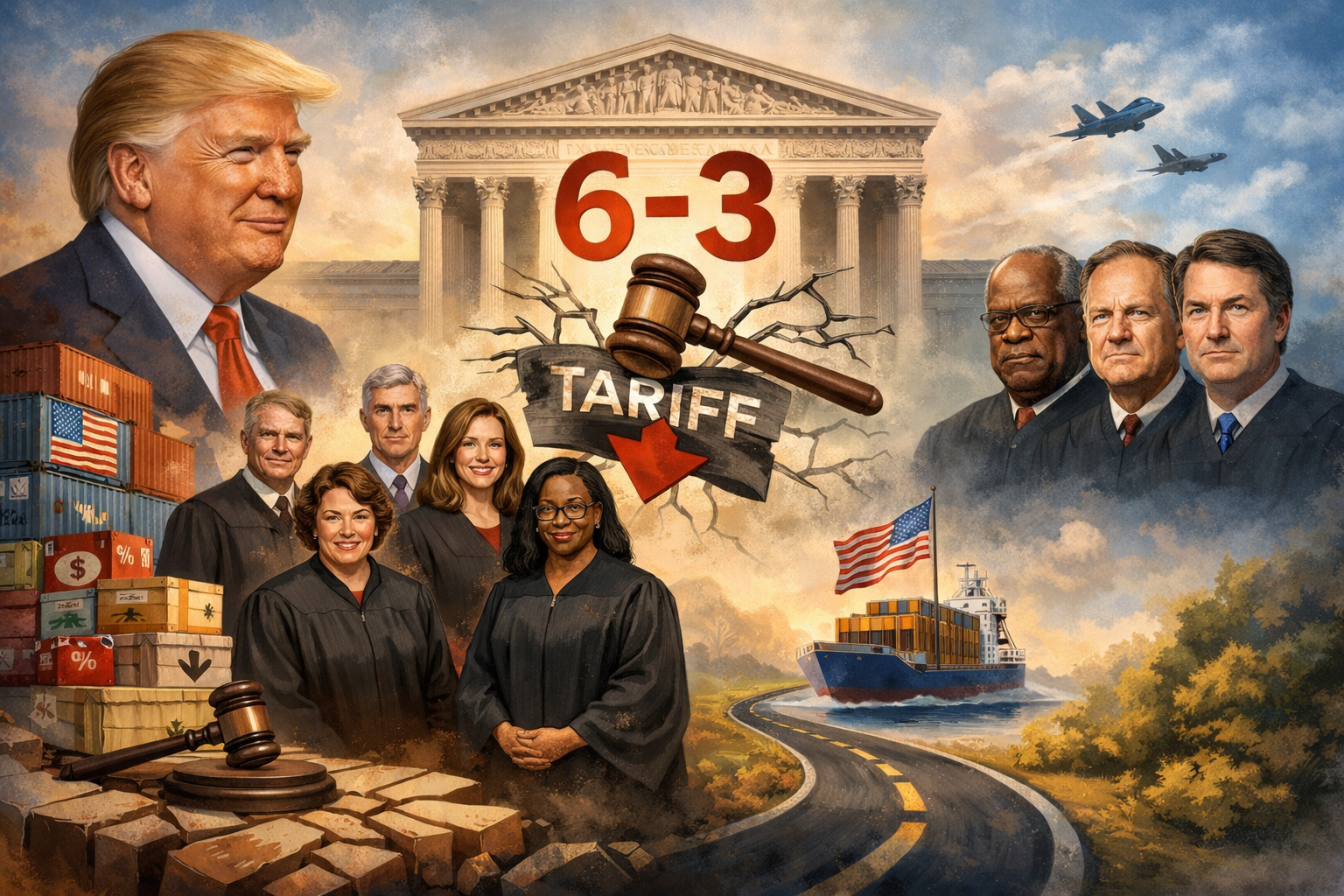
On February 20th, the Supreme Court delivered a significant rebuke to President Trump’s implementation of his signature tariff policy, the centerpiece of his economic agenda, by a 6 to 3 vote. Chief Justice John Roberts wrote the majority decision in which two Trump-appointed Supreme Court Justices, Neil Gorsuch and Amy Coney Barrett, concurred. The Court’s three liberal justices, Elena Kagan, Sonia Sotomayor and Ketanji Brown Jackson, joined the majority. Justices Brett Kavanaugh, Clarence Thomas and Samuel Alito dissented.
The Supreme Court ruled that the president had exceeded his constitutional and legislative authority by imposing “tariffs of unlimited amount and duration, on any product from any country” in reliance upon the International Emergency Economic Powers Act (IEEPA). President Trump “must identify clear congressional authorization to exercise it,” which the Court concluded he had failed to do.
During his press conference afterwards, President Trump expressed anger at the decision but said that he would turn to alternative statutes that leave no doubt as to his tariffing authority. The Trump Derangement Syndrome sufferers and countries thinking that President Trump has lost his trade negotiation leverage should be careful what they wish for. There will be delays before the president can fully invoke these alternative statutes and some confusion with respect to the disposition of tariffs already collected by the Trump administration under the IEEPA authority it thought it had. But President Trump’s tariff policy is still very much alive.
President Trump has already issued a proclamationinvoking Section 122 of the Trade Act of 1974, which authorizes the president to take action through surcharges and other special import restrictions to address fundamental international payments problems on a temporary basis. Pursuant to that authority, President Trump proclaimed that “all articles imported into the United States shall be subject to a 10 percent ad valorem duty rate” with certain limited exceptions. He has since raised this rate to 15 percent, the maximum allowed by Section 122. There are other sources of statutory authority that give the president the powers he needs to use tariffs for national security purposes and to counter other countries’ unfair and discriminatory trading practices.
The Supreme Court tariff decision lacks nuance in its interpretation of the IEEPA. It does not take adequate account of the deference that is normally accorded to the president in foreign policy and national security matters. Justice Kavanaugh explained in his dissenting opinion that “tariffs on foreign imports are significant tools of foreign policy and national security, whether imposed under IEEPA,” or other statutes. The Court majority should have made more allowances for exigent national security and foreign policy concerns that would justify President Trump’s use of tariffs under the IEEPA in specific circumstances. Countering China’s threat to cut off the supply of critical rare minerals is an example. Pressuring China, Canada, and Mexico to stop the flow of deadly fentanyl into the United States is another.
The Supreme Court decision is also faulty in neglecting to say anything about whether refunds would be required to importers for the many billions of dollars in tariffs already collected. As Justice Kavanaugh noted in his dissenting opinion, “One issue will be refunds. Refunds of billions of dollars would have significant consequences for the U. S. Treasury. The Court says nothing today about whether, and if so how, the Government should go about returning the billions of dollars that it has collected from importers. But that process is likely to be a ‘mess,’ as was acknowledged at oral argument.”
But there are two silver linings in the Supreme Court’s ruling. It acknowledges the President’s authority to invoke the tariffing authorities provided in other statutes. And barring the executive branch’s use of the IEEPA to justify exercising extraordinary powers that Congress has not explicitly authorized sets an invaluable precedent to stymie a future leftwing president from implementing a progressive agenda by emergency fiat. As Justice Gorsuch wrote in his concurrence, “if history is any guide, the tables will turn and the day will come when those disappointed by today’s result will appreciate the legislative process for the bulwark of liberty it is.”
The majority opinion relies upon the separation of powers principle and a strict adherence to the text of the IEEPA that does not explicitly authorize the President to impose a “tax,” “tariff,” or “duty.” It points out that there are other statutes that specifically authorize the President to impose tariffs, but which contain procedural guardrails and limits on time, scope, and amounts.
“All it takes to unlock that extraordinary power is a Presidential declaration of emergency, which the Government asserts is unreviewable. And the only way of restraining the exercise of that power is a veto-proof majority in Congress,” the chief justice wrote. “That view, if credited,” he emphasized, would represent a “‘transformative expansion’ of the President’s authority over tariff policy…and indeed — as demonstrated by the exercise of that authority in this case — over the broader economy as well.”
Chief Justice Roberts noted that “Article I, Section 8, of the Constitution sets forth the powers of the Legislative Branch,” which includes the “Power To lay and collect Taxes, Duties, Imposts and Excises.” A tariff is regarded as a tax and the power to impose and collect taxes and duties is exclusively reserved to Congress unless it delegates such power to the executive branch in clear and unambiguous terms.
The IEEPA explicitly authorizes the president to “investigate, block during the pendency of an investigation, regulate, direct and compel, nullify, void, prevent or prohibit . . . importation or exportation.” But none of these enumerated powers – including the power to “regulate” – explicitly confers authority upon the president to impose a tax, including a tariff.
Under the Supreme Court’s “major questions doctrine,” broad assertions of power that the executive branch claims it has legislative authority to exercise on issues of political or economic significance to the nation must be clearly authorized by Congress. “When Congress grants the power to impose tariffs, it does so clearly and with careful constraints. It did neither here,” Chief Justice Roberts declared. “IEEPA’s grant of authority to ‘regulate . . . importation’ falls short. IEEPA contains no reference to tariffs or duties. The Government points to no statute in which Congress used the word ‘regulate’ to authorize taxation. And until now no President has read IEEPA to confer such power.”
The majority opinion is so literal in its textual approach to interpreting the IEEPA that it has lost the forest for the trees. Yes, the IEEPA uses specific words to describe what the president is authorized to do regarding imports after he has proclaimed an emergency. These words include “block,” “nullify,” “void,” “prevent,” “void,” “prohibit,” and “regulate,” but not the words “tax,” “duties,” or “tariff.” Relying on this wording alone as Chief Justice Roberts does, however, leads to an illogical conclusion. It defies common sense that the president has the authority to prohibit or prevent imports from a country altogether but not to use less drastic means to regulate importation through the kind of economic pressure that tariffs would exert.
No worries, however. President Trump has other statutes in his toolbox that give him explicit legislative authority to impose tariffs in addition to Section 122 of the Trade Act of 1974. Section 301 of that same statute authorizes the Office of the U.S. Trade Representative to impose tariffs on a foreign country it determines, after an investigation, to be engaging in “unreasonable or discriminatory” conduct that adversely affects U.S. commerce. Section 1338 of the Tariff Act of 1930 authorizes the president to impose “new or additional duties” of up to 50 percent of the product’s value on countries that have discriminated against the commerce of the United States. Section 232 of the Trade Expansion Act authorizes the president to impose tariffs on foreign products on national security grounds after a Commerce Department investigation determines that an import poses a national security risk.
In short, the Supreme Court has dealt President Trump a setback but nothing that cannot readily be worked around under other existing statutes. One thing is for sure, however. The Supreme Court, including the conservative justices appointed by President Trump, has proven that the Left’s obituary for the independence of the nation’s highest court is extremely premature.