Visual Journalism teamBBC News

 BBC
BBC
The war in Ukraine is now in its fifth year. Over the past few months, Russian forces have slowly expanded the amount of territory they control, mostly in the east of Ukraine, and have continued their barrage of air strikes on Kyiv and other cities.
Some 55,000 Ukrainian soldiers have been killed, according to Ukrainian President Volodymyr Zelensky, while the BBC has confirmed the names of almost 160,000 people killed fighting on Russia’s side.
Four years after Russia’s full-scale invasion, here’s a look at the situation on the ground in Ukraine.
Russia grinds forward in the east
Analysts at the US-based Institute for the Study of War (ISW), say Russia took about 4,700 sq km (1,800 sq miles) of territory in 2025 – an area about twice the size of the city of Moscow – although Russia claims to have taken 6,000 sq km.
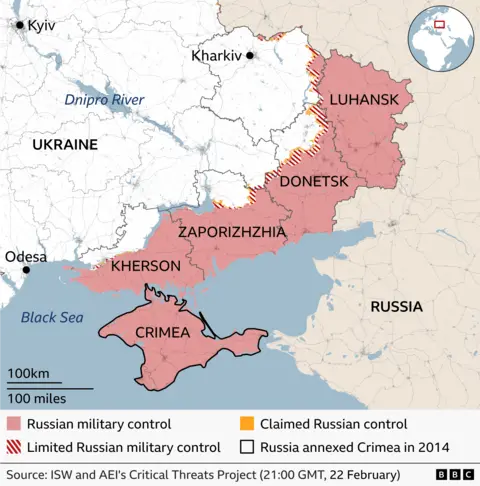
In eastern Ukraine, Moscow’s war machine has been churning mile by mile through the wide open fields of the Luhansk and Donetsk regions – also known as the Donbas – surrounding and overwhelming villages and towns.
It has been trying to gain full control of the area along with two more regions to the west – Zaporizhzhia and Kherson. Shortly after the invasion, Russia held referendums to try to annexe all these regions – in the same way it had annexed Crimea in 2014 – but it has never had them under full control.
There is some evidence that Elon Musk’s decision to deny Russian forces access to his Starlink satellite-based internet service at the start of February has given Ukraine an advantage.
Ukraine requested the move as evidence grew that Starlink was enabling Russian forces to mount increasingly accurate attacks, including multiple instances of units being attached to drones, allowing operators to use real-time video links to guide drones on to targets.
In some areas of the long front line, especially east of the city of Zaporizhzhia, Russian forces appear to have been forced to retreat.
Ukraine hopes that any territorial gains will strengthen the its position at the negotiating table.
It comes after a US-backed peace plan unveiled in November, suggested Ukraine could cede control of all of Luhansk, Donetsk and Crimea, along with the areas of Zaporizhzhia and Kherson that Russia currently occupies, to Moscow.
Ukrainian forces would have had to withdraw from parts of Donetsk they still hold and this would become a demilitarised area under de facto Russian control. Russian forces would withdraw from the small areas of Ukraine they currently occupy outside those regions.
Zelensky has consistently said Ukraine will not hand over the Donbas in exchange for peace, saying such a concession could be used as a springboard for future attacks by Russia.
Key towns targeted
A recent report by the ISW describes a “fortress belt” running 50km (31 miles) through western Donetsk.
“Ukraine has spent the last 11 years pouring time, money, and effort into reinforcing the fortress belt and establishing significant defence industrial and defensive infrastructure,” it writes.
A Russian summer offensive near the eastern town of Pokrovsk did make rapid advances just north of the town and Russia has recently made advances in the town itself and to the east of nearby Kostyantynivka.
The town, once a key logistics hub for Ukraine’s military, is already in ruins.
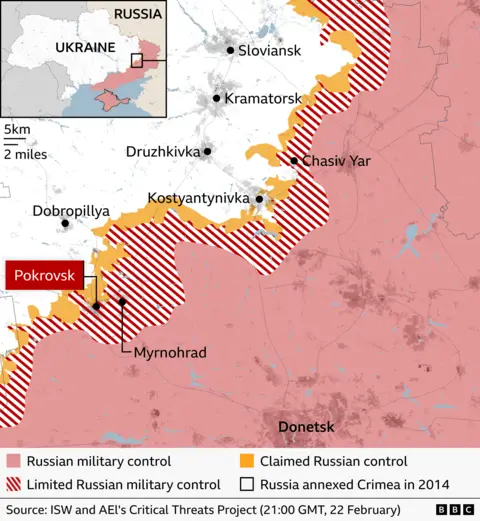
Russian officials previously claimed to have captured Pokrovsk, known in Russian as Krasnoarmeysk, which includes a major road and railway junction that used to connect the upper parts of the Donetsk region with key cities to the west, such as Dnipro.
But Ukraine says it still holds northern parts of the town.
Its fall would be Russia’s biggest battlefield victory since it took the city of Avdiivka about 40km (25 miles) to the east in early 2024 and could give Moscow a platform to drive north towards the two biggest remaining Ukrainian-controlled cities in the Donetsk region, Kramatorsk and Sloviansk.
Ukraine is losing ground, but the ISW notes Russia has been trying to take Pokrovsk – a town of about 23 sq km – for nearly two years and that the cities in the fortress belt are “significantly larger”.
It suggests that it would take Russian forces another two years to seize the remainder of the Donetsk region “at great cost”.
Russian incursion north of Kharkiv
Further north on the main front line, Russia has been trying to advance on the city of Kupyansk, which analysts suggest could allow it to encircle the northern Donetsk region.
It has also been trying to push Ukrainian forces back from the border with the Russian region of Belgorod.
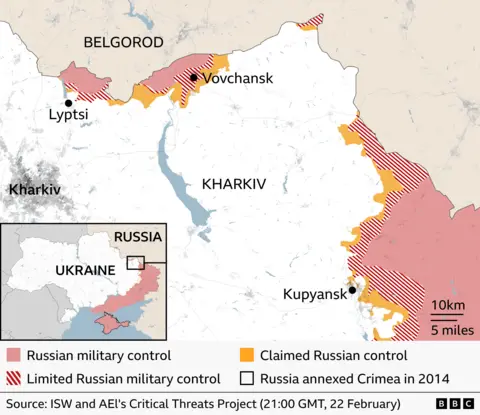
ISW analysts say Russia is trying to create a buffer zone inside Ukraine’s northern borders and get within artillery range of Kharkiv, Ukraine’s second-biggest city.
Russia’s forces have recently gained limited control over a spear of land to the south of Vovchansk that would bring them closer to this target.
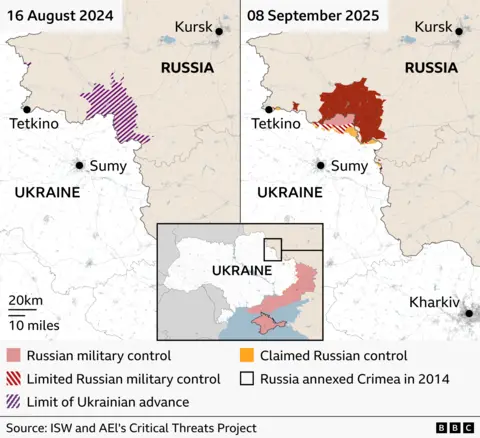
Russian President Vladimir Putin says he wants this buffer zone to protect Russia, after Ukrainian forces captured a swathe of territory further north in Kursk in the summer of 2024. Russian forces eventually drove them out, with the help of North Korean troops.
The Russian Defence Ministry confirmed the attacks had occurred in five regions of Russia – Murmansk, Irkutsk, Ivanovo, Ryazan and Amur – but stated planes had been damaged only in Murmansk and Irkutsk, while in other locations the attacks had been repelled.
Most recently, an overnight Russian attack was reported on 22 February in Kyiv and around the capital city, where dozens of strikes targeted energy infrastructure.
Prior to this, a massive attack by Ukrainian drones on Volzhsky, in the Volgograd region in Russia, was reported on 11 February.
Russia has also been carrying out strikes on Ukrainian infrastructure – in particular its energy facilities such as electricity substations and power plants.
Several people have been killed in the attacks and tens of thousands of people across Ukraine have experienced severe power cuts or been left with no running water or heating during some of the coldest months of the winter.
Ceasefire talks
These attacks were paused for a week following a request from US President Donald Trump to Putin.
Trump has been leading efforts to end the war through negotiations, and Zelensky said this month that the US wanted the war to end by June.
However, the most recent round of talks between Russia, Ukraine and the US in Geneva, Switzerland, concluded without a breakthrough on 18 February.
Some progress was made on “military issues”, including the location of the front line and ceasefire monitoring, according to a Ukrainian diplomatic source.
White House spokeswoman Karoline Leavitt said later that “there was meaningful progress” made on both sides, and an agreement to “continue to work towards a peace deal together”.
But an agreement on the issue of territory – without which no ceasefire can be envisaged – remains elusive, with Moscow and Kyiv’s positions still far apart.
Three years of fighting
Russia’s full-scale invasion began with dozens of missile strikes on cities all over Ukraine before dawn on 24 February 2022.
Russian ground troops moved in quickly and within a few weeks were in control of large areas of Ukraine and had advanced to the suburbs of Kyiv.
Russian forces were bombarding Kharkiv, and had taken territory in the east and south as far as Kherson, and surrounded the port city of Mariupol.
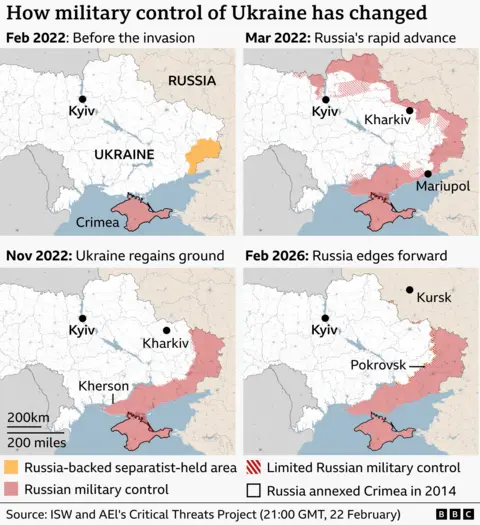
But they hit very strong Ukrainian resistance almost everywhere and faced serious logistical problems with poorly-motivated Russian troops suffering shortages of food, water and ammunition.
Ukrainian forces were also quick to deploy Western supplied arms such as the Nlaw anti-tank system, which proved highly effective against the Russian advance.
By October 2022, the picture had changed dramatically and, having failed to take Kyiv, Russia withdrew completely from the north. The following month, Ukrainian forces recaptured the southern city of Kherson.
Since then, the battle has mostly been in the east of Ukraine with Russian forces slowly gaining ground over many months.
Both Kyiv and Moscow have regularly published estimates of the other side’s losses but they have been reluctant to detail their own.
As of six months ago, Ukraine’s interior ministry had recorded more than 70,000 people as officially missing – both soldiers and civilians – but the breakdown is never given and the true figure may be higher. However, Zelensky said at the start of February that 55,000 soldiers had been killed.
By Dominic Bailey, Mike Hills, Paul Sargeant, Chris Clayton, Kady Wardell, Camilla Costa, Mark Bryson, Sana Dionysiou, Gerry Fletcher, Kate Gaynor and Erwan Rivault
About these maps
The situation in Ukraine is often fast moving and it is likely there will be times when there have been changes not reflected in the maps.