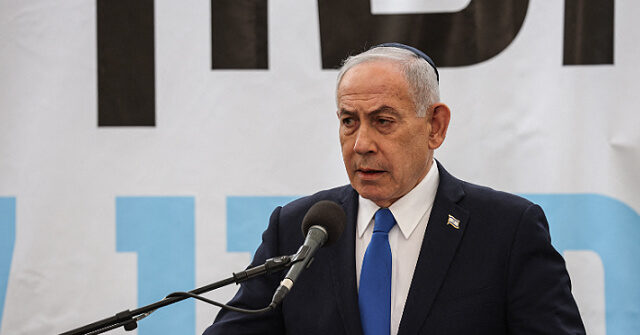
Israel’s Prime Minister Benjamin Netanyahu warned Monday that the Iranian regime would face “a force they cannot even imagine” should it attack the Jewish state, as U.S. refueling and cargo aircraft landed at Ben Gurion Airport and an American carrier strike group advanced toward the eastern Mediterranean amid escalating regional tensions.
Addressing the Knesset — Israel’s parliament — during a special debate, Netanyahu said the country is navigating “very complex and challenging days,” cautioning that “no one knows what tomorrow will bring.”
He said he had conveyed a direct message to Tehran: if it makes “perhaps the most serious mistake in its history” and strikes Israel, the response will be overwhelming.
“We will respond with a force they cannot even imagine,” he declared.
Netanyahu called on Israelis to stand “shoulder to shoulder,” saying this is not a moment for internal divisions but for national unity as tensions intensify.
He noted that he had just returned from a summit meeting with U.S. President Donald J. Trump, describing coordination between Jerusalem and Washington — including ties between the IDF and the U.S. military — as closer than ever.
“Israel has never been stronger,” Netanyahu said.
His remarks came as Boeing KC-135 refueling aircraft and C-17 Globemaster transport planes were documented earlier in the day at Ben Gurion Airport. At least two refuelers reportedly arrived from Al Udeid Air Base in Qatar, the largest U.S. base in the Middle East.
Meanwhile, the USS Gerald R. Ford — the world’s largest aircraft carrier — was seen near Crete after being dispatched to the region earlier this month to join the USS Abraham Lincoln, which is already deployed.
More than 200 U.S. fighter jets are now positioned across the Middle East, according to regional security assessments.
Defense analysts tracking open-source flight and naval data report that over 85 aerial refueling tankers and more than 170 cargo aircraft have surged into the region since mid-February — marking the largest buildup of American naval and air power in the Middle East since the 2003 Iraq war, though without a comparable ground force.
Further signs of heightened alert emerged in Lebanon, where the United States reduced its embassy presence in Beirut to essential personnel only, evacuating roughly 50 staff members and family members as a precaution. The embassy remains operational.
Inside Israel, hospitals have accelerated emergency preparations.
Soroka Medical Center in Beersheba — which was struck by a ballistic missile in June 2025 — has conducted large-scale simulations and refined patient transfer protocols in preparation for a potential new campaign. Wolfson Medical Center in Holon has relocated departments and cleared underground areas, while Assuta Medical Center in Tel Aviv opened a fortified underground complex capable of accommodating approximately 200 patients to ensure continuity of care under sustained missile threat.
Municipal authorities have also reviewed emergency readiness, with several cities confirming public shelters would automatically open in the event of an attack.
The military buildup comes as renewed talks between Washington and Tehran are scheduled for Thursday in Geneva. Trump’s special envoy Steve Witkoff and Jared Kushner are expected to meet Iranian Foreign Minister Abbas Araghchi in what Israeli officials view as a narrowing diplomatic window following earlier rounds that failed to produce results.
On Monday afternoon, President Trump pushed back against reports suggesting senior Pentagon officials had warned him against military action.
“Numerous stories from the Fake News Media have been circulating stating that General Daniel Caine … is against us going to War with Iran,” Trump wrote on Truth Social, calling the claims “100% incorrect.”
Trump said Joint Chiefs Chairman Gen. Dan Caine believes that if military action is ordered, it would be “easily won,” and emphasized that he alone will decide whether to strike.
“I am the one that makes the decision,” the president wrote, adding that while he prefers a deal, “if we don’t make a Deal, it will be a very bad day for that Country.”
The president’s remarks followed media reports outlining Pentagon assessments of potential risks associated with a prolonged campaign, including casualties and broader regional escalation. No final decision has been announced.
Meanwhile, new anti-regime protests were reported at multiple universities in Tehran following the reopening of campuses, with footage showing clashes between students and Basij militia forces.
Netanyahu closed his address with a sober reminder of the uncertainty ahead.
“No one knows what tomorrow will bring,” he said. “But we are prepared for any scenario.”
Joshua Klein is a reporter for Breitbart News. Email him at jklein@breitbart.com. Follow him on Twitter @JoshuaKlein.