Order Josh Hammer’s new book, Israel and Civilization: The Fate of the Jewish Nation and the Destiny of the West: HERE.
For decades, the House of Saud played a rather duplicitous game on credulous Westerners.
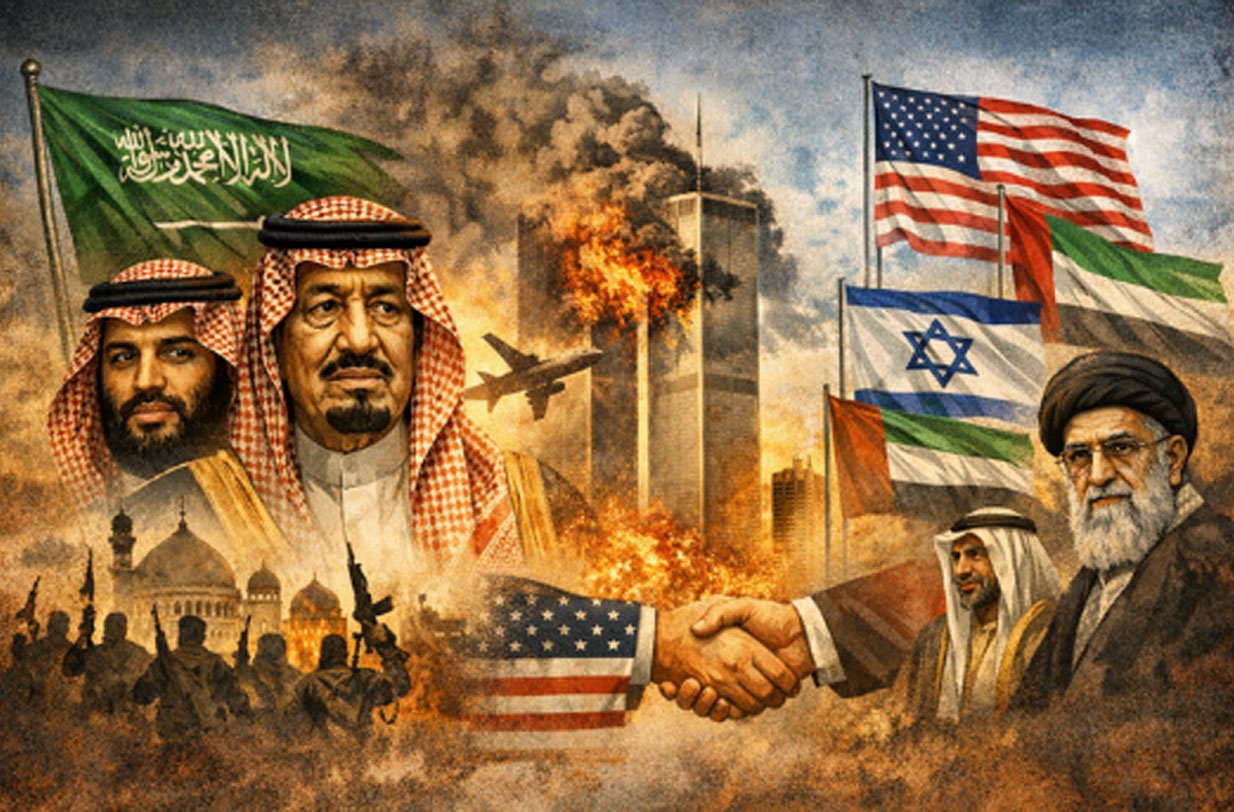
Officially, Riyadh was a longstanding linchpin of America’s geopolitical strategy in the ever-volatile Middle East—condemnatory of Islamist excess and vocally critical of the revolutionary Shiite regime in Tehran. Unofficially, the regime still spread Islamism—primarily through Salafist and Wahhabi clerics and madrasas, which the House of Saud funded and exported far beyond its petroleum-rich shores. Fifteen of the nineteen 9/11 hijackers, to take but one particularly macabre example, were Saudi nationals. The kingdom mostly talked the talk, and it certainly was preferable to the monstrous Khomeinist regime—but it didn’t exactly walk the walk, either.
It took the rise of a ruthlessly ambitious and Western-curious young crown prince, Mohammed bin Salman (MBS), to crack down on the radical clerics and straighten out Saudi Arabia’s image.
In 2014, the kingdom declared the Muslim Brotherhood, the organizational mother’s milk of Sunni Islamism, as a terrorist organization. For nearly four years, beginning in 2017, MBS oversaw a Saudi-led Gulf Cooperation Council (GCC) diplomatic and economic boycott of Qatar due to the emirate’s infamous support of the Brotherhood and its dissemination of Islamist propaganda via its state-sponsored Al Jazeera network. It is also commonly accepted that Riyadh gave its imprimatur of legitimacy when fellow Gulf monarchies Bahrain and the United Arab Emirates (UAE) signed the Abraham Accords in 2020—the first normalization agreements between Israel and the Arab world since Jordan made peace in 1994.
All seemed to be going mostly well. But in recent months, the House of Saudi has been rebranding itself—and not for the better.
In state-sanctioned sermons in the holy cities of Mecca and Medina, Saudi imams recently called on Allah to support “our downtrodden brothers in Palestine,” to “reverse their weakness into strength,” and to grant them “victory against the Zionist aggressors.” In case it was missed, the same message was broadcast from the kingdom’s airwaves. A few weeks ago, Israeli journalist Amit Segal observed: “Over the past month, Al Arabiya has been worse than Al Jazeera in the texts broadcast against any normalization with Israel.” The House of Saud has also turned on its long-time moderate Sunni ally, the UAE—bombing Emirati-backed forces in Yemen on December 30 and now opposing Abu Dhabi everywhere from Somalia to Libya to Syria. In each theater, the House of Saud has taken the side of Islamists, in contrast to UAE-backed non-Islamists. Riyadh mouthpieces now condemn Abu Dhabi as Zionist-controlled.
What the heck is going on here—and most important, what does it all mean for the United States and our very real interests in the Middle East?
First, the much-desired goal of Riyadh joining Abu Dhabi and Manama in the Abraham Accords circle of peace with Jerusalem is, at least for the time being, totally unachievable. A friend of mine who had been involved in the first Trump administration’s Abraham Accords diplomacy efforts once told me that, by the end of the first Trump term, a deal to bring Riyadh into the accords was “on the five-yard line.” This same official believed that, if Trump had been re-elected for a second term beginning in January 2021, Saudi Arabia would have joined the accords within a few months. Now, five years later, the notion of Israel normalizing relations with the state custodian of Islam’s holy sites is, sadly, a pipe dream.
Second, it seems that Riyadh’s recent shift in posturing is motivated less by a sincere ideological cottoning to Islamism—the Brotherhood remains officially banned throughout the kingdom, for example—and motivated more by MBS’s unseemly personal petulance and immaturity. It’s worth remembering that MBS, a nepo baby if there ever were one, has behaved like a spoiled child before. He initiated a high-profile mass arrest of prominent Saudi elites at the Riyadh Ritz-Carlton in November 2017. In October 2018, Islamist “journalist” Jamal Khashoggi was butchered at the Saudi consulate in Istanbul; a CIA report the following month concluded that MBS had ordered the hit. Whatever one might say (and I have nothing nice to say about Khashoggi), these incidents were unnecessarily provocative—perhaps even gratuitous.
It seems that MBS is now up to his old tricks. By all accounts, MBS has come to loathe Mohamed bin Zayed, rule of Abu Dhabi and president of the UAE. I’ve heard speculation that MBS now harbors an even deeper hatred of MBZ, and by extension the entire UAE, than he held for Qatar and its ruling House of Thani during the 2017-2021 GCC crisis. Given that the UAE under MBZ has been perhaps the most moderate of all the oil-rich Sunni Gulf states in its general approach to Islam and the most publicly embracing of Israel of all the Abraham Accords’ Arab signees, there is no clear reason why MBS has adopted such a hostile posture—given his years of anti-Islamist crackdowns and purges—other than pure pettiness and jealousy.
It’s juvenile—blatantly, insanely, and disgustingly so. But as Riyadh cozies up to Recep Tayyip Erdogan’s strongman Islamist regime in Ankara, Ahmed al-Sharaa’s al Qaeda-lite regime in Damascus, and sides against Israel and the UAE on Somaliland’s push for national autonomy, MBS’s spoiled outbursts nonetheless have real consequences for the region.
The broader saga is also a reminder of the bitter and inherently tribal nature of Arab society. As I explained for Tablet in 2021, in an essay about the Israeli-Palestinian conflict:
One intriguing idea is what Bar Ilan University Professor Mordechai Kedar calls the “emirates plan,” modeled after the eponymous Gulf state. Just as the UAE is a loose confederation of disparate Arab tribes, each overseeing its own tribal land, so too could the deeply fractious Palestinians of Judea and Samaria confederate into a series of non-contiguous, Palestinian “emirates” based around the relevant tribes’ home cities. That kind of plan is “based on the sociology of the Middle East, which has the tribe as the major cornerstone of society,” as Kedar has explained.
The tribal nature of Arab society explains how nominally similar inbred monarchies like Saudi Arabia, the UAE, and Qatar can end up hating each other’s guts, boycotting and at times even bombing one another. Seemingly, it’s just built into the very fabric of who they are as Arabs.
For better or for worse, the Trump administration has done serious, big-bucks business with the House of Saud. Accordingly, Washington has plenty of leverage when it comes to the kingdom. Trump should use that leverage to bring America’s putative ally back in line—it should act aggressively, and posthaste. But Riyadh’s recent moves are also a reminder that even “moderate” Arab Muslim regimes are, at the end of the day, still Arab Muslim regimes. They can never, ever be truly trusted—certainly not when it comes to advancing America’s core interests in the Middle East of containing the Islamic Republic of Iran, containing non-state Islamism, and ensuring that crucial international waterways remain open and navigable.
There is precisely one American ally in the Middle East that can be relied upon to consistently secure and advance our core national interest in the region: the Jewish state of Israel. As President Trump gets closer and closer to making a final decision as to whether or not he will enforce his own red line on the murderous mullahs of Iran, that is something he ought to bear in mind.
In order to eliminate spam comments that have historically flooded our comments section, comments containing certain keywords will be held in a moderation queue. All comments by legitimate commenters will be manually approved by a member of our team. If your comment is “Awaiting Moderation,” please give us up to 24 hours to manually approve your comment. Please do not re-post the same comment.