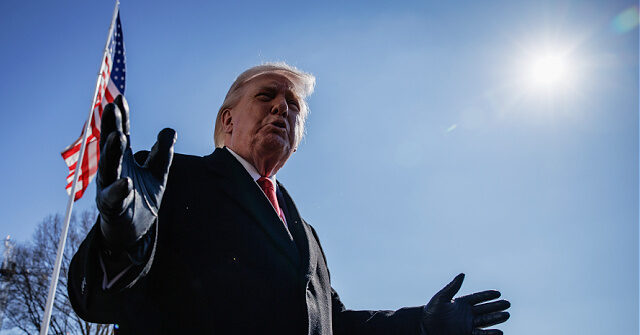
President Donald Trump said Monday he will be “indirectly” involved in Tuesday’s high-stakes nuclear talks with Iran in Geneva, expressing confidence Tehran wants “to make a deal” while warning that he does not believe the regime wants “the consequences of not making a deal” as U.S. military forces continue building pressure across the Middle East.
Speaking to reporters aboard Air Force One as he returned to the White House, Trump framed the talks as pivotal — a renewed diplomatic push unfolding alongside visible American force posture and contingency planning should negotiations fail.
“I’ll be involved in those talks, indirectly. And they’ll be very important,” Trump said. “We’ll see what can happen.”
Calling Iran “a very tough negotiator,” Trump argued the regime miscalculated in prior rounds.
“I would say they’re bad negotiators because we could have had a deal instead of sending the B-2s in to knock out their nuclear potential — and we had to send the B-2s,” he said, referencing last year’s U.S. strikes on Iranian nuclear facilities following stalled diplomacy.
Asked about assessments that reaching an agreement may be “next to impossible,” Trump pushed back.
“No, no. I think they want to make a deal,” he said. “I don’t think they want the consequences of not making a deal. They want to make a deal.”
Tuesday’s talks in Geneva will involve Trump’s envoys Steve Witkoff and Jared Kushner, with Oman again serving as mediator following the first round held in Muscat. Iran will be represented by Foreign Minister Abbas Araghchi, who arrived in Switzerland leading what Tehran described as a diplomatic and technical delegation.
Araghchi met Monday with International Atomic Energy Agency Director General Rafael Grossi for what both sides characterized as substantive technical discussions ahead of the renewed indirect negotiations.
Writing on X, Araghchi said he was in Geneva “with real ideas to achieve a fair and equitable deal,” adding pointedly, “What is not on the table: submission before threats.”
Iran’s deputy foreign minister, Majid Takht-Ravanchi, echoed that posture, saying, “The ball is in America’s court.” Tehran, he indicated, is prepared to discuss elements of its nuclear program — including enrichment levels and stockpiles — provided sanctions relief is part of the conversation.
“We are ready to discuss this and other issues related to our program, provided that they are also ready to talk about the sanctions,” he said.
The diplomatic track is unfolding against a sharpened American military backdrop.
A New York Times report on Friday detailed how the Pentagon has used the diplomatic window to reinforce both offensive and defensive capabilities in the region, moving additional air defenses, naval assets, and strike platforms into position while preparing options that could extend beyond nuclear sites if ordered.
CNN reported Monday that U.S. air and naval assets are continuing to reposition closer to the Middle East, including fighter aircraft, refueling tankers, and missile defense systems, as part of a buildup designed to both deter Tehran and provide credible strike options should negotiations collapse.
CBS News further reported that Trump told Israeli Prime Minister Benjamin Netanyahu in December he would support Israeli strikes on Iran’s ballistic missile program if diplomacy fails, with internal U.S. discussions now focused on how Washington might assist, including aerial refueling and operational coordination.
Iran, for its part, paired diplomacy with muscle-flexing.
On the eve of the Geneva talks, the Islamic Revolutionary Guard Corps conducted a naval drill in and around the Strait of Hormuz — a vital global energy chokepoint — describing it as preparation for “potential security and military threats.” Iranian state media emphasized what it called a decisive response capability in the maritime arena.
Secretary of State Marco Rubio reinforced the administration’s dual-track posture Monday, describing Iran’s ruling clerics as decision-makers driven by “pure theology,” while stressing that U.S. forces in the region are positioned defensively to protect American personnel even as negotiations proceed.
In Israel on Monday, Sen. Lindsey Graham (R-SC) said the president is running “two lines in the water” — one diplomatic, one military — and argued that a decision point is approaching “in weeks, not months.” Graham also stressed there is “no daylight” between Trump and Netanyahu on Iran policy.
U.S. Ambassador to Israel Mike Huckabee similarly said Washington and Jerusalem are “fully coordinated” as talks resume.
For Trump, the message heading into Geneva is clear: diplomacy remains open, but the leverage behind it is unmistakable.
“I think they’ll be successful,” Trump said Friday of the negotiations. “And if they’re not, it’s going to be a bad day for Iran — very bad.”
Joshua Klein is a reporter for Breitbart News. Email him at jklein@breitbart.com. Follow him on Twitter @JoshuaKlein.