
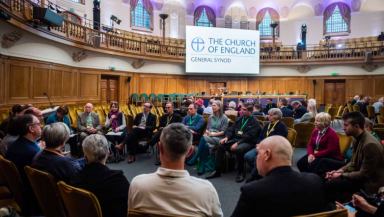
Living in Love and Faith (LLF), the years-long process of discernment in the Church of England that led to same-sex blessings, is to be formally wound down in July.
General Synod, the Church’s parliamentary body, approved a motion to end the process during a debate on Thursday.
It means that the Church of England, for now at least, will not be introducing standalone gay blessing ceremonies in churches.
The motion, moved by the Archbishop of York, Stephen Cottrell, also asked Synod to “recognise and lament the distress and pain many have suffered during the LLF process, especially LGBTQI+ people”.
Addressing Synod, Archbishop Cottrell said, “This is not where I want us to be, nor where I hoped we would be three years ago. And I want to acknowledge that wherever you stand on the debate, I know that many of you are feeling angry and disappointed.”
The motion also thanked members of the LLF Working Groups for their “committed and costly work” over the years, and commended the House of Bishops in establishing two new groups to continue working on the issues beyond LLF – the Relationships, Sexuality and Gender Working Group and Relationships, Sexuality, and the Gender Pastoral Consultative Group.
The motion was carried by a majority in all three Houses, with bishops voting 34 in favour, with 0 against; clergy 109 in favour and 62 against with 10 abstentions; and laity 109 in favour, with 70 against and 9 abstentions.
LLF was launched in November 2020 as a Church-wide process of listening and discernment on questions around gender identity, sexuality, relationships and marriage, with a view towards agreeing on provisions for same-sex couples in church.
It led to Synod approving same-sex blessings within regular services during its February 2023 sessions. Churches that wanted to were able to begin using the Prayers of Love and Faith in December that year.
The House of Bishops then began to consider introducing standalone services for same-sex blessings but ultimately concluded after receiving legal and theological advice that this would not be possible unless formal synodical and canonical requirements maintaining legal and doctrinal integrity could be met.
This is because the Church of England’s official doctrine of marriage remains defined as a lifelong union between a man and a woman, whereas it was feared that standalone services would give the impression of a change in doctrine.
The bishops were also keen to avoid a situation where there would be delegated episcopal ministry for traditionalist congregations unable to accept standalone same-sex blessing ceremonies.
Oxford vicar Vaughan Roberts said that although LLF and the prospect of it continuing was “exhausting”, he did not think there was “enough acknowledgement that a completely new approach is needed to avoid us going round and round again in the next synodical process”.
He suggested there were two options on the table, one being the “winner takes all” by securing the necessary majorities in Synod – likely leading to many evangelicals leaving the Church.
“The damage will be profound, let’s not do that,” he said.
The second option – his preference – was to work towards a settlement – something the Bishop of Chelmsford, Dr Guli Francis-Dehqani, said earlier in the debate was not on the table at this moment in time.
Rev Roberts said, “I would plead with all three houses to accept the pain of a radical differentiation by settlement, which will be a lesser pain than the alternatives. Otherwise we’ll continue to be in pain, continue to be exhausted for years to come.”
Archbishop of Canterbury, Dame Sarah Mullally, said, “I recognise that LLF has been hard. It has left us wounded as individuals and also as a Church. And therefore I am grateful that you are still here.”
She added, “I know that the proposals this afternoon may well be disappointing for some but I do believe it proposes a sensible way forward that provides us with a structured framework that will take us to the next steps.”
Much of Thursday afternoon was spent discussing LLF. Some LGBT Christians spoke of their pain and hurt, but conservative Anglicans suggested the process has been just as punishing for them.
“Those like me, who hold to the historic teaching, also feel that pain, and all groups need to be recognised,” said Simon Clift, a lay member from the Diocese of Winchester.
London lay member, Busola Sodeinde, took umbrage with the way that traditionalists, including those who have spoken out in Global South provinces, have sometimes been dismissed as “homophobic”.
“To refer to them as ‘homophobic’ as some have, when they believe that they are seeking to remain faithful to God’s word is not only unhelpful, it is gravely unjust,” she said.
During a presentation on LLF earlier in Synod, Archbishop Cottrell said conversations would continue even though the process is formally ending.
He admitted that the Church “remains divided” on the issues raised by LLF, as does the House of Bishops.
Speaking to the latter, he said, “When we came in 2023, even though we came with great unanimity, I think it very quickly became clear that actually we had different understandings of what we were bringing, and perhaps weren’t honest with ourselves about the fact that we weren’t united — that has become clear. It’s been a sober thing to learn, but perhaps it’s better and more honest for us to say.”

