Aleem MaqboolReligion editor

 PA Media
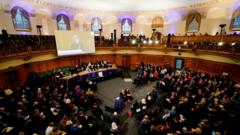
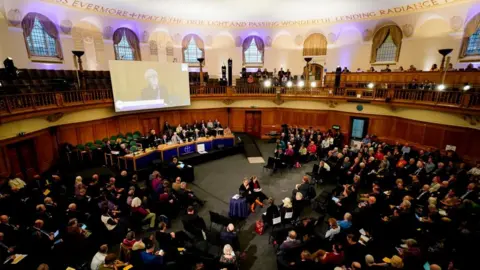
The Church of England’s national assembly has formally abandoned proposals to deliver blessing ceremonies for same-sex couples in churches.
General Synod did vote to continue to look into the issue in the future, but bishops had already decided there were theological and legal barriers to having such ceremonies now.
There was emotional testimony from some gay Christians during the Synod debate and warnings that many liberals and LGBT people were abandoning the Church.
Church leaders apologised for the hurt caused to “both sides”, with conservatives having also complained about a lack of clarity from bishops about traditional teaching about marriage and sexuality.
“This is not where I want us to be, nor where I hoped we would be three years ago. And I want to acknowledge that wherever you stand on the debate, I know that many of you are feeling angry and disappointed,” said the Archbishop of York Stephen Cottrell at Synod on Thursday.
In early 2023 after 10 years of bitter debate, the Church of England finally decided that, unlike some other Anglican churches like the Scottish Episcopal Church, it would not support gay marriage.
Instead, it proposed church “blessings” for same-sex couples, a move that was endorsed by a Synod vote, and a process was set up to try to work out how stand-alone blessing ceremonies for gay couples could work.
But this Synod has marked the end of that process, the work on which is estimated to have cost £1.6m.
Apologising for the pain caused, the Archbishop of York put forward a proposal to set up a working group to continue discussing the issue.
“You have broken my heart. I cannot believe that we are here again, after all this time, with only this to offer,” the Reverend Charlie Bączyk-Bell, a gay priest and member of Synod based in London, said.
Dr Bączyk-Bell said the process had been a “facetious charade” and it was a “false equivalence” to talk about hurt caused to those who had been theologically opposed to the idea of marriage equality.
“It is not the same to have your entire self debated, ripped apart, dissected, insulted, trampled on in this chamber and more widely as though it were a mere abstract question,” he said.
Through tears, Dr Bączyk-Bell apologised to LGBTQ+ members of the Church of England affected “for what we continue to put you through” and “that we cannot celebrate you the way we should”.
Although both gay marriage and stand-alone blessing ceremonies for same-sex couples are now off the table in the Church of England, blessing prayers for such couples that form part of ordinary Sunday church services have been allowed since 2023.
The Church of England Evangelical Council (CEEC) has previously said same-sex blessings are “contrary to the teaching of the Bible”, and during Thursday’s debate, some insisted it was not just LGBT+ Christians that had been left scarred by developments.
“Those like me, who hold to the historic teaching, also feel that pain, and all groups need to be recognised,” said Simon Clift, a lay member of Synod from Winchester.
Busola Sodeinde, another lay member of Synod from London said Anglicans in the “Global South” were “wounded” and felt that they had not been adequately consulted.
“To refer to them as ‘homophobic’ as some have, when they believe that they are seeking to remain faithful to God’s word is not only unhelpful, it is gravely unjust,” she said.
Although the decisions of Synod do not directly affect what Anglican churches around the world teach, some such churches have threatened to leave the Anglican Communion over the issue of blessings for same-sex unions.
But in 2017 the Episcopal Church in Scotland went much further and voted for marriage equality for gay couples.
And while the Anglican Church in Wales does not allow same-sex weddings, it has also taken greater steps than the Church of England by authorising blessing services for gay couples.
Although Synod voted on Thursday for a working group to be set up to continue to discuss the issue, some upset by the collapse of the process to offer same-sex blessing services warned many were abandoning the Church in disappointment.
At the end of Thursday’s debate, the new Archbishop of Canterbury, Dame Sarah Mullally, addressed Synod talking of the difficulties of navigating the issue in recent years.
“It has touched some of our deepest theological views but also the core part of our identity. It has left us wounded as individuals and also as a Church and therefore I am grateful that you still are here,” Dame Sarah said.
Additional reporting by Catherine Wyatt.