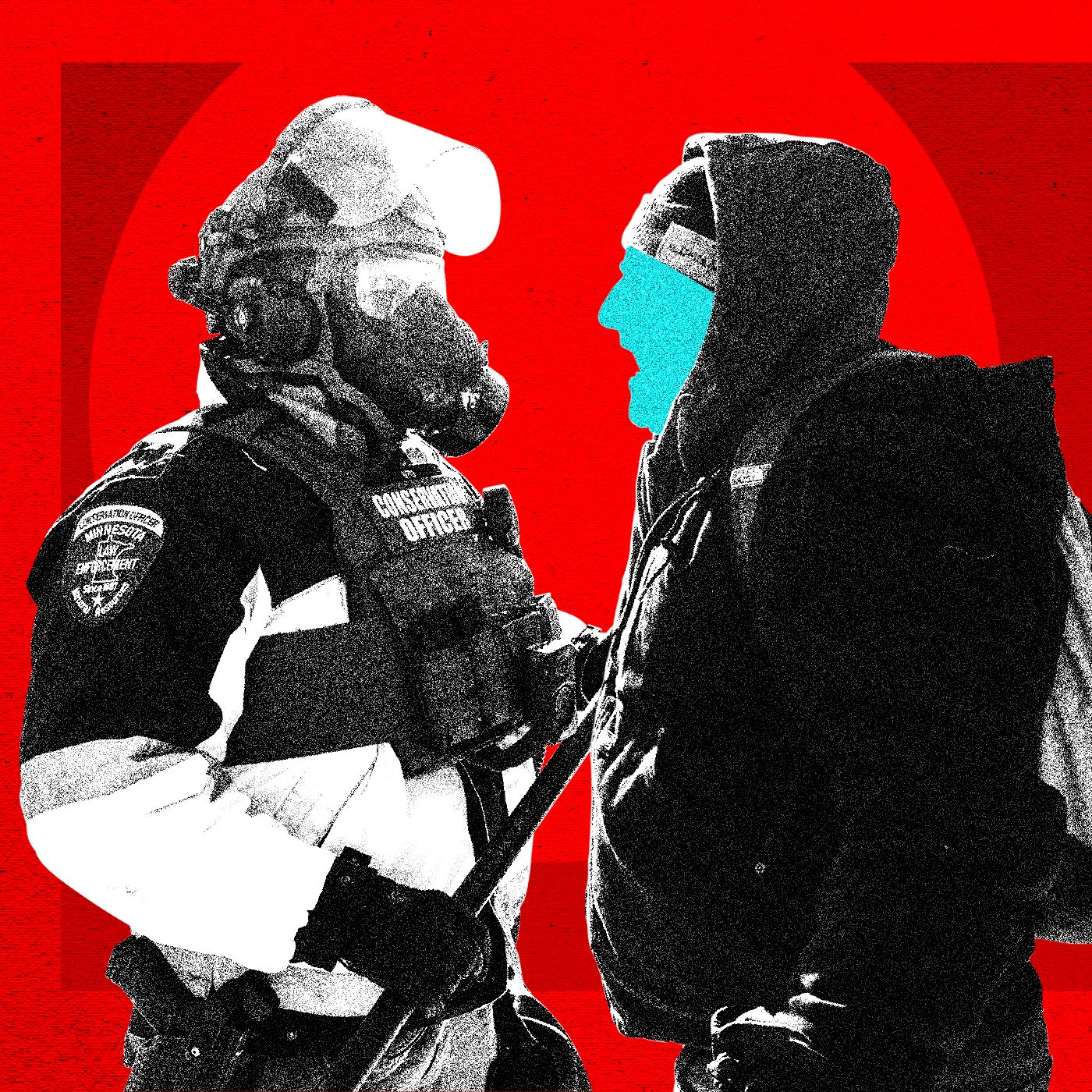
At first glance, the scuffle in the video seems shocking. A New York City school principal, waving a bat, stops masked ICE agents from trying to enter the building behind her, and instead of violence, the encounter erupts with cheers from onlookers. “Let me show you why they call me bat girl,” she says to them. In other clips like it, a server flings a bowl of hot noodles at two officers dining at a Chinese restaurant, and a shop owner flexes her Fourth Amendment rights. None of the encounters end in bloodshed.
The videos, equal parts tense and bombastic, are also clearly AI-generated. They are part of a constellation of anti-ICE AI content that is spreading across social media as the federal occupation of Minneapolis—part of the Trump administration’s attack on immigrants—has resulted in agents killing two US citizens in January. Both Renee Nicole Good, a 37-year-old mother of three, and Alex Pretti, a 37-year-old US Department of Veterans Affairs ICU nurse, were unarmed when they were fatally shot by government officials.
In America, the role of fantasy—the act of imagining a better world and putting action behind it to make it true—is paramount during times of political unrest. The videos, which have millions of views on Facebook and Instagram, offer a blend of revisionist justice that imagines a digital multiverse where the ICE agents are just like us: not above the rule of law.
In the aggregate, anti-ICE AI videos are a way for people to push against the distortions painted by the Trump administration and MAGA influencers to justify their actions, says AI creator Nicholas Arter. “Over the last decade, social media served that role by giving a voice to people who lacked access to traditional media. It’s not surprising that with AI, another major technological shift, we’re seeing similar patterns repeat, with people using the tools available to articulate emotions, fears, or resistance.” But while they might feel cathartic, the videos themselves are also a type of distortion. That can have consequences, whether bolstering the narrative that people of color are agitators, or making the public more skeptical of actual video evidence.
An account going by the name Mike Wayne, whose owner declined multiple requests for comment, appears to be one of the genre’s most prolific posters. The account has uploaded more than 1,000 videos, often of people of color fighting off ICE agents, to his Instagram and Facebook pages since Good was shot on January 7. Tonally, the clips read like digital counternarratives: ICE agents taking a perp walk, an officer getting slapped by a Latina woman, a priest pushing masked officials out the doors of his church, announcing, “I don’t know what god you worship, maybe an orange one, but my god is love.” (In reality, federal agents arrested roughly 100 clergy members last week during a protest at the Minneapolis-Saint Paul airport, where faith leaders said an estimated 2,000 people had been deported from.)
The videos create an alternative timeline where the passion and anger of Americans resisting the federal occupation of their cities doesn’t cost lives—and accountability actually matters. One of Wayne’s most-watched clips is of an ICE agent fighting white tailgaters at a sporting event, a vision seemingly so surreal it has been viewed 11 million times in less than 72 hours. “Down with fascism,” one person says in the background. Humor also plays an important role in these fan-fiction-style videos. In a clip posted by the meme account RealStrangeAI, four drag queens in neon wigs chase ICE officers through a Saint Paul neighborhood.
“This is fake. ICE can’t run,” wrote one commenter.
“Love it. Don’t care if it’s ‘fake,’ want to see it inspire,” responded another.
Arter, who founded the creative consultancy AI for the Culture, says it’s difficult to assign a single motivation to those creating these videos. Some “do come across like fan fiction,” he says, but other creators are likely “chasing virality or monetization by leaning into controversial or emotionally charged content.”
Currying political capital online involves demonstrating that the opinions you hold are widely held while also engineering viral content that aligns with your views, says Joshua Tucker, codirector of New York University’s Center for Social Media, AI, and Politics. “I suspect the goal of making these kinds of AI-generated videos is to draw on both of these strategies: to add more anti-ICE content to social media and to potentially make popular anti-ICE content so that it goes viral.”
AI manipulations have also become an especially effective, if sometimes bizarre, tool for political influence by the Trump administration. A week ago, the White House posted an altered photo of civil rights attorney and former Minneapolis NAACP president Nekima Levy Armstrong after she was handcuffed during an arrest for a peaceful demonstration at Cities Church over the previous weekend; it described her as a “far-left agitator.”
According to a Survey Monkey analysis, 73 percent of marketers say AI plays a role in creating personalized experiences, while a 2024 Graphite study noted that more than 50 percent of new articles on the web were being generated by AI. As resistance movements continue to leverage online channels—to communicate, mobilize, and critique their governments—AI will be unavoidable in how it is used by and against people as they fight for democratic freedoms.
Filmmaker and AI creator Willonious Hatcher believes the anti-ICE videos have resonated with people because they imagine a shared desire for liberation. “The oppressed have always built what they could not find,” he says. “But the question is not whether these videos are helpful. The question is what they tell us about this country, that people must fabricate images of their own liberation because the real thing remains out of reach. These videos are not delusion. They are diagnosis. A people does not dream this loudly of fighting back unless they have learned that the systems meant to protect them will not.”
But AI can just as easily amplify misinformation.
Video evidence has been crucial to documenting ICE’s actions and has played a critical role in dispelling false narratives about the deaths of both Good and Pretti. It’s a fact the Department of Homeland Security seems acutely aware of. Good’s partner was recording an ICE officer seconds before he killed Good. Pretti was also recording on his phone when he was gunned down. Protesters have likewise been bullied by federal agents simply for documenting what is happening before them.
Tucker says there is concern that the increasing flood of anti-ICE AI content could potentially backfire by contributing to “a general perception that you just can’t trust videos when you see them anymore,” making it “harder to convince people of the fact that things which are actually real are, in fact, real.” This played out on Wednesday, with new footage of Pretti confronting ICE officers on January 13, more than a week before he was killed, posted by media outlet The News Movement; on Instagram and YouTube, many commenters accused the video of being AI generated. (Pretti’s family has confirmed to the New York Times that it was him.)
And, at a time when protesters are being labeled “domestic terrorists” by the state, there are consequences to anti-ICE AI content that largely show people of color being confrontational to authority. “That confusion can lead individuals to feel justified in taking actions based on narratives that aren’t grounded in reality, which is where the real danger lies—not just in the content itself, but in how it’s interpreted and acted upon,” Arter says.
“America has always been eager to punish the dreamer rather than confront the conditions that made dreaming necessary,” Hatcher says. “These videos will become the excuse, not because they justify force but because justification was never the point. The point is permission. And this country has always been generous with permission when the targets are the right ones.”